Comparison
Coaching vs a DIY Workout Plan (Free Program, YouTube, or Self-Programming)
Free and DIY workout plans — a YouTube program, a Reddit routine, a spreadsheet you built yourself — can absolutely produce results, and the honest starting point is admitting that. What they can't do is adjust when your week doesn't go as planned, tell you if your form has quietly drifted, or notice that you've plateaued for six weeks because nobody's watching the data. A generic plan assumes generic circumstances: a fixed schedule, no injuries, consistent motivation. Real weeks aren't like that. The actual decision point isn't 'is a coach better than a free plan' — a well-designed free program can be genuinely good — it's whether you have the experience to self-diagnose when something's off (a plateau, a form breakdown, a life disruption) and adjust accordingly. If you do, DIY can work indefinitely. If you don't yet, or if you've been running the same self-made plan for months without deliberate progression, that's the specific gap coaching closes.
Cost snapshot: A DIY workout plan costs $0. 1:1 online coaching with Kris Oddo, NASM-CPT, is a paid investment. The decision isn't whether $0 is cheaper than coaching — it is — but whether a static workout list will actually produce your goal when real-life schedule disruptions, plateaus, and form drift occur.
Quick answer
Is a free DIY workout plan or a coach better for you?
A DIY workout plan is better if you already know how to train, can accurately self-diagnose plateaus, and have the discipline to adjust your volume and nutrition when life changes. 1:1 coaching with Kris Oddo, NASM-CPT at Geebs Coaching is better if you keep restarting free plans, run the same spreadsheet routine for months without progression, or need a weekly feedback loop to stay accountable when work and life get busy.
Key Differences Summary
The short version of Geebs Coaching vs DIY Workout Plan.
| What matters | Geebs Coaching | DIY Workout Plan |
|---|---|---|
| Best fit | Geebs CoachingBusy lifters who need a coach to adapt training and nutrition when work, travel, stress, or consistency problems show up. | DIY Workout PlanSelf-directed lifters who can write, execute, and adjust their own training and nutrition without outside guidance. |
| Personalization | Geebs CoachingBuilt from a full intake and updated weekly based on check-in data, lift trends, and real schedule changes. | DIY Workout PlanFixed template or static spreadsheet. No mechanism to adapt when life disrupts your schedule. |
| Accountability | Geebs CoachingDaily check-in messages and a dedicated weekly review with Kris Oddo to catch missed sessions early. | DIY Workout PlanZero external accountability. If you miss workouts or stop entirely, the spreadsheet does not notice. |
| Decision point | Geebs CoachingChoose coaching when you know basic training concepts but struggle with consistency, plateaus, or form drift. | DIY Workout PlanChoose DIY when execution is already reliable, you enjoy self-programming, and budget is your sole constraint. |
Side by side
Geebs Coaching vs DIY Workout Plan (free YouTube programs, Reddit routines, or self-made spreadsheets).
| Dimension | Geebs Coaching | DIY Workout Plan |
|---|---|---|
| Cost | Paid 1:1 coaching investment with exact package details covered on your strategy call. | Free ($0) for YouTube videos, Reddit program wikis, or self-built spreadsheets. |
| Program Adaptation | Weekly programming changes based on target lift progression, recovery markers, and travel schedules. | Static workout list. Adjustments rely entirely on your own programming knowledge. |
| Form Feedback | Video review of your heavy lifts with specific coaching cues from Kris Oddo, NASM-CPT. | Self-assessment by comparing your videos to YouTube exercise tutorials. |
| Plateau Troubleshooting | Coach diagnoses whether fat loss or muscle gains have stalled from nutrition, sleep, or volume. | Trial-and-error guessing when lift numbers or body measurements stop moving. |
| Nutrition Integration | Custom calorie and protein targets adjusted alongside your training phase (cut, recomp, bulk). | Requires separate self-managed tracking apps and independent calorie calculation. |
| Accountability & Follow-up | Daily communication and weekly check-ins so small slip-ups don't turn into missed months. | None. Motivation must come 100% from internal discipline every week. |
Pick Geebs if
- You've been following a free plan or self-made routine for 6+ weeks with no change in lifts or mirror.
- You struggle to stay consistent when work trips, family demands, or stress disrupt your routine.
- You want expert form feedback so you can push heavy weights without joint pain.
- You're done guessing whether a plateau requires fewer calories, more sleep, or a deload week.
Pick DIY Workout Plan if
- You are brand new and want to test your consistency for 30 days before investing.
- You genuinely enjoy researching training science and designing your own periodized programs.
- Your lifts and body measurements are improving steadily week after week on your current routine.
- Financial budget is your main limitation right now and you have strong self-discipline.
Proof trail
What backs the Geebs side of this comparison
Comparison pages should connect the offer to proof, not just repeat feature claims. These are the public results, named testimonials, and coach-identity pages that support the Geebs side of the argument.
Tracked 16-week average
25 lb
Average fat loss across 15 completed clients tracked over 16 weeks. Individual results vary.
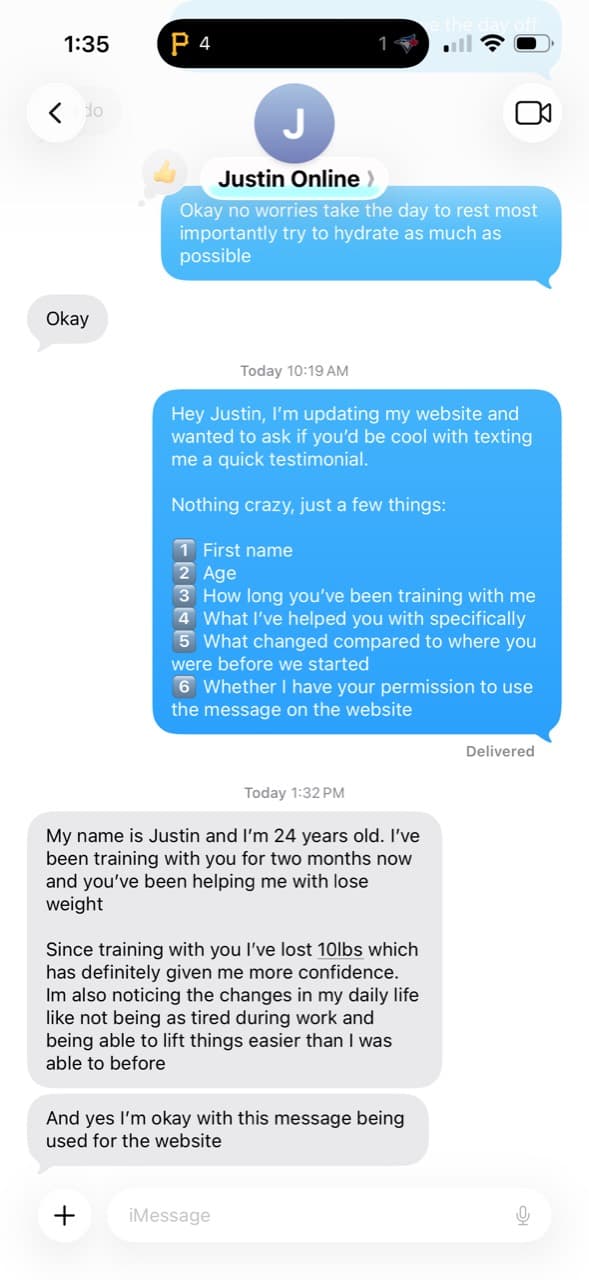
2 months - down 10 lb, more confidence, more energy
Down 10 pounds and carrying more confidence into daily life.
“I've lost 10 lb, which has definitely given me more confidence. I'm not as tired during work and I can lift things easier than before.”
Justin
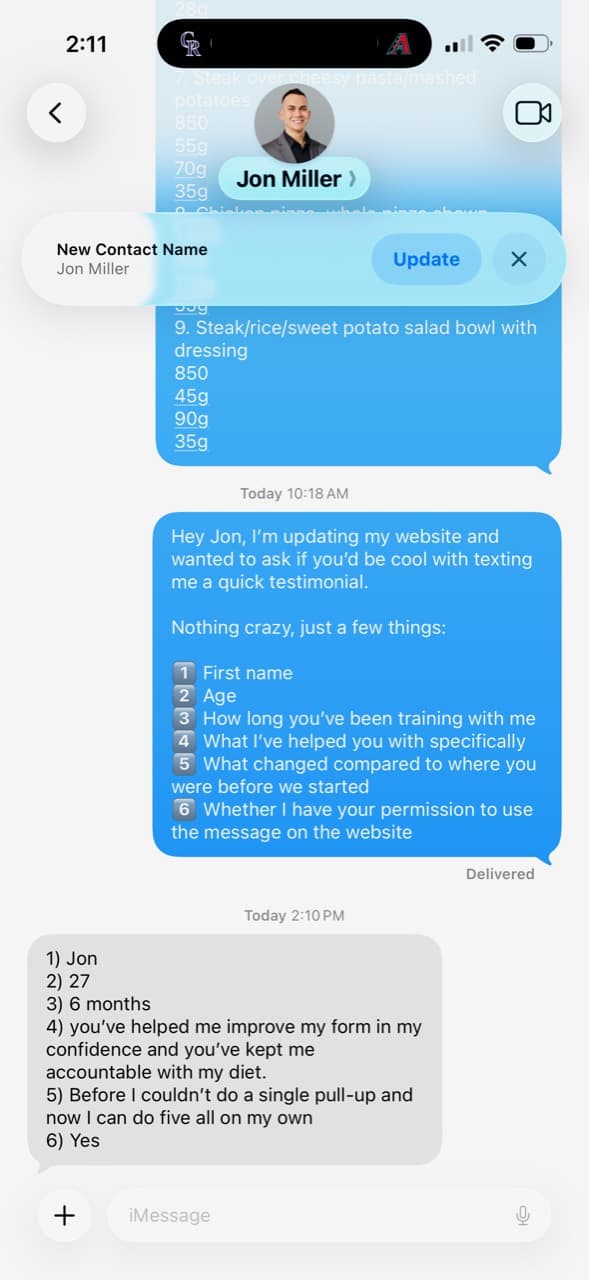
6 months - better form, diet accountability, 5 pull-ups
From zero pull-ups to five on his own.
“Before I couldn't do a single pull-up, and now I can do five all on my own.”
Jon Miller
Google review - 5/5
Public review mentioning Kris directly
“Great staff. Even greater experience. Would definitely recommend to anyone looking to improve themselves. Kris is the person you want to take it to that next level.”
Jake Ross - 11 months ago
Bottom line
A free DIY workout plan — whether from YouTube, Reddit, or a spreadsheet — is a valid starting point for learning basic exercises. But information is rarely what keeps lifters from building their goal physique. A static plan cannot notice when you've gone quiet, cannot catch form drift, and cannot adjust when work trips disrupt your week. Coaching provides the weekly adaptation and accountability built around the program. If self-coaching were going to yield your target physique, your current self-made plan would already have delivered it.
When is a free or DIY workout plan genuinely enough?
If you are progressing on your primary compound lifts, eating sufficient protein, and your body composition is moving in the right direction, you do not need to pay for a coach. A well-designed free program works indefinitely if you have the experience to self-diagnose plateaus and adjust your own volume and recovery.
Free routines available on Reddit or YouTube can provide excellent exercise selection and basic progressive overload rules. For lifters who have the discipline to track every session and the technical knowledge to fix form flaws, self-programming is a satisfying, cost-effective option.
How do I decide between a DIY plan and a coach in two minutes?
To evaluate your current setup, ask three direct questions. First: have your primary lifts or your mirror physique improved over the last eight weeks? Second: if progress has stopped, do you know the precise programming or nutrition variable to fix it, and are you executing that fix? Third: is your biggest hurdle a lack of exercise information, or is it consistency, form validation, and accountability?
If your numbers are moving and you know your next training block, keep going on your DIY plan. If you have stalled for two months and either don't know why or know the fix but fail to stick to it, that specific gap is what 1:1 coaching resolves. The point of a coach is not to replace your effort, but to make the work you are already putting in actually pay off.
Why doesn't 'I already train' automatically mean I don't need adjustments?
Experienced lifters often fall into the trap of confusing effort with progression. You can train with high intensity five days a week and still see zero muscle growth or fat loss if your fatigue management, rep ranges, or calorie targets are off. Training hard without a feedback loop usually means repeating the same 12-week block for three years while expecting a different physique.
Controlled research confirms the value of direct oversight. A randomized controlled trial by Mazzetti et al. (2000) (PMID: 10862549) evaluated direct supervision versus self-directed resistance training over 12 weeks. The supervised group achieved significantly greater strength gains and load progression because weights were systematically adjusted based on real-time performance. Furthermore, a systematic review and meta-analysis of randomized trials by Lacroix et al. (2017) (PMID: 28573401) demonstrated that supervised exercise protocols yield superior compliance and physical outcomes compared to unsupervised self-directed routines.
Honest limits of the evidence: While direct supervision in randomized trials produces greater strength increases and adherence, these studies evaluate short-term protocol compliance rather than multi-year lifestyle maintenance in busy working adults. A coach provides the structural oversight that self-directed lifters miss.
What is it that a DIY workout plan cannot do when life changes?
A static PDF or spreadsheet assumes ideal conditions: uninterrupted sleep, zero travel, perfect stress recovery, and unyielding motivation. Real work weeks are rarely ideal. When a work trip cuts your gym access from four days to two, a spreadsheet gives you no guidance on how to consolidate volume.
A static PDF or spreadsheet assumes generic life circumstances; coaching adapts the training to what your actual week looks like. When fatigue accumulates or an old shoulder twinge returns, a coach modifies your exercise variation on the fly so you keep making progress without risking injury.
Are free YouTube workout plans a bad place for complete beginners to start?
Free YouTube workout plans are not inherently bad; in fact, they are often a great, low-friction entry point for beginners to learn basic movement patterns. The risk for a complete beginner isn't the quality of the video demonstration, but the absence of personalized form feedback and exercise selection matched to their mobility.
Free beginner programs provide solid exercise templates, but they cannot correct drifting form or fix poor exercise selection before bad habits set in. Starting with a free program is a reasonable test of consistency, but switching to 1:1 coaching ensures your lifting technique is safe and effective as weights get heavy.
How do I know if my self-made workout program has quietly stalled?
The most common indicator of a stalled DIY program is six consecutive weeks without progress on your core lifts or waist measurements despite full compliance. If your squat or bench press has stayed at the exact same weight for two months, continuing the same spreadsheet routine will not magically break the plateau.
When your lifts and body measurements stay flat for six consecutive weeks on the same program, your self-made plan has reached a plateau that requires deliberate programming changes. Knowing whether you need a deload, a change in exercise variation, or an adjustment to your calorie deficit requires external data analysis—which is why so many experienced lifters eventually transition from DIY plans to structured 1:1 coaching.
If you are evaluating options between self-coaching and coaching, explore our guides on breaking a strength training plateau or how much an online fitness coach costs. You can also compare 1:1 coaching against fitness apps and ChatGPT self-coaching.
Compare other options
Most people comparing online coaching are choosing between an app, an in-person trainer, self-coaching, or a coach-led model. These comparisons keep the alternatives connected so you can judge the real tradeoff.
Geebs vs Future
Coach-led 1:1 support compared with app-based coaching.
Geebs vs Caliber
Custom coach attention compared with app-first training.
Geebs vs a personal trainer
Online accountability compared with local session-based training.
Geebs vs ChatGPT
Human coaching judgment compared with self-coaching through AI.
Geebs vs fitness apps
1:1 coaching versus self-guided app programs — price, adherence, and who each fits.
Geebs vs Trainwell
Named 1:1 coach compared with Trainwell's trainer-marketplace app model.
Geebs vs AI fitness coaches
1:1 human coaching versus the AI fitness coaching category — what AI gets right and where the adherence gap still matters.
Geebs vs a gym membership
A cheap membership vs a coached plan — cost per result, not cost per month.
Geebs vs group fitness classes
1:1 coaching compared with F45, Orangetheory, and CrossFit-style class formats.
Common questions
Is a free workout plan from YouTube or Reddit good enough to get results?
Many free workout plans from Reddit wikis or established YouTube channels are genuinely well-designed. The gap isn't the plan's quality — it's what happens when your week doesn't match the plan, which a static program can't adjust for.
Do I need a coach if I already know how to train?
Not automatically. Experienced lifters who can self-diagnose plateaus and adjust their own programming often don't need one. However, if you've been training hard without seeing changes in your lifts or body composition for 6+ weeks, an external set of eyes closes the execution gap.
How do I know if my self-made program has stopped working?
If your main lifts or key body measurements have been flat for 6+ consecutive weeks and the program hasn't changed in that time, that is the clearest sign your self-made plan has quietly plateaued.
What's the actual difference between a free plan and a coached one?
A free plan is fixed. A coached plan changes weekly based on what actually happened — missed sessions, fatigue, recovery, and results — which a static PDF or spreadsheet can't do.
Is it a waste of money to hire a coach if I could just follow a free program?
It depends entirely on whether you will actually adjust the free program correctly when life disrupts it. That weekly adjustment and accountability is the paid part, not the workout list itself.
Should complete beginners start with a free plan or a coach?
Either can work. A free, well-reviewed beginner program is a reasonable start; coaching removes the risk of drifting form or poor exercise selection going uncorrected for months.
Still evaluating?
If you are not ready to apply yet, use the pages that answer the real questions behind every comparison: how Kris coaches, what online coaching usually costs, whether it is worth paying for, and whether the method has proof behind it.
How it works
Read the methodology
Training, nutrition, recovery, accountability, and why Geebs is built for a real work week.
Proof
Review client results
Real client results, reviews, and how the coaching actually works.
Cost
Compare online coaching prices
See what changes the price, when 1:1 makes sense, and when a lower-cost path is the better fit.
Buying guide
Decide if online coaching is worth it
Use the fit checks before choosing an app, a self-guided plan, or high-touch 1:1 coaching.
Checklist
How to hire an online fitness coach
Credentials, programming quality, check-in cadence, red flags — what to look for in an online coach before you pay.
Keep going
Free coaching tip
Want a useful coaching tip before you go?
Try Geebs Coaching
The application is three questions and takes under two minutes. If it's not a fit, you'll get pointed to the 90-day program.