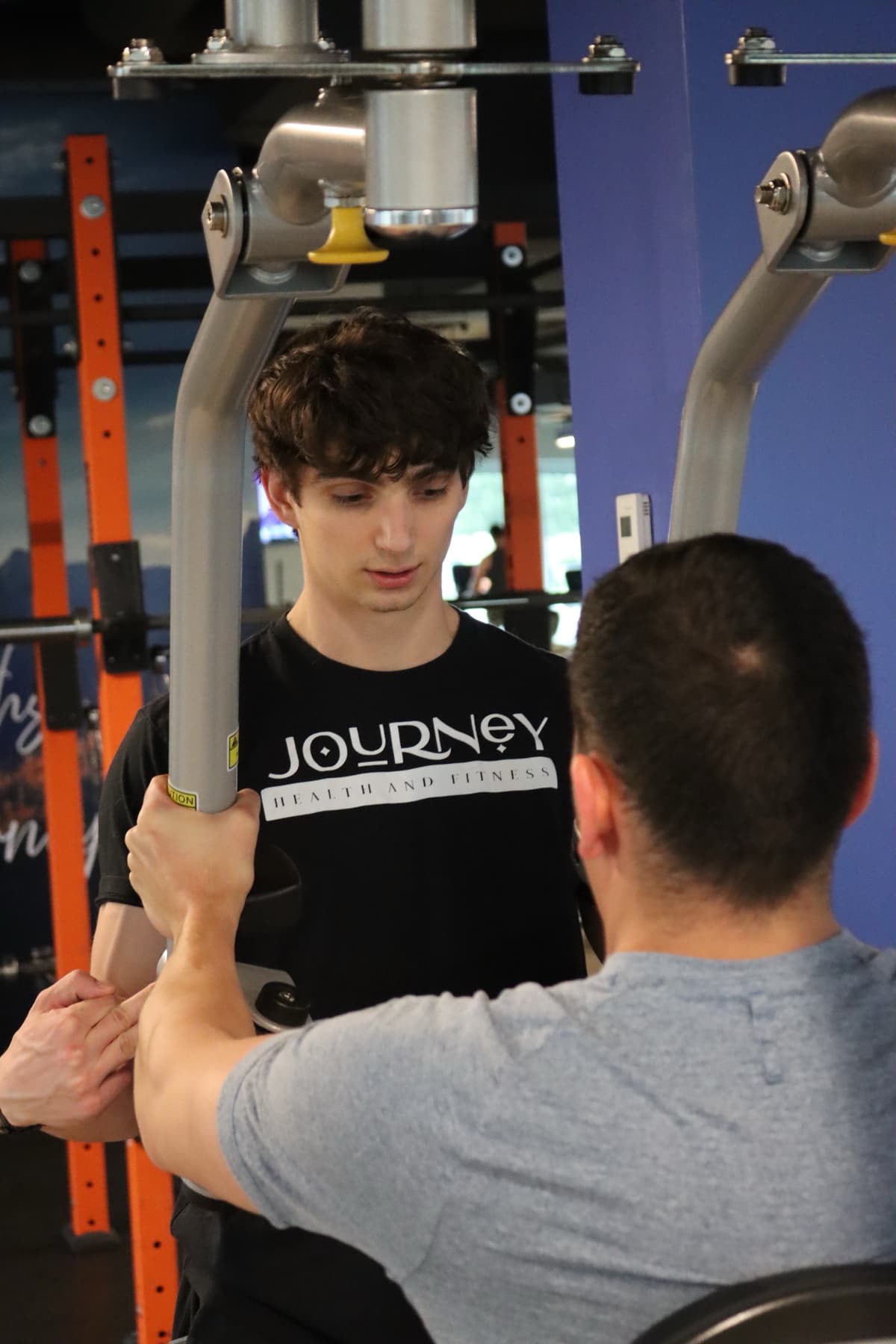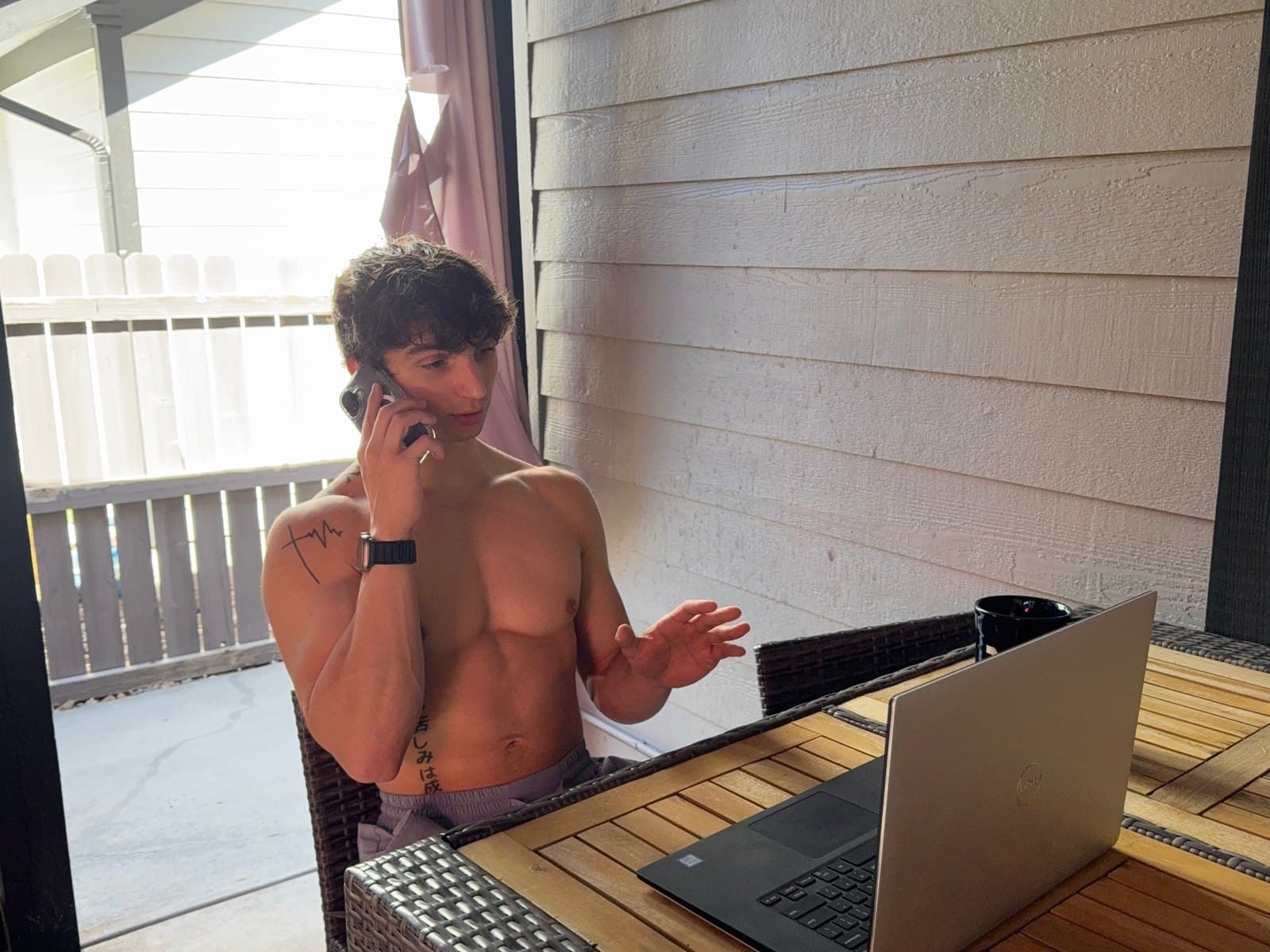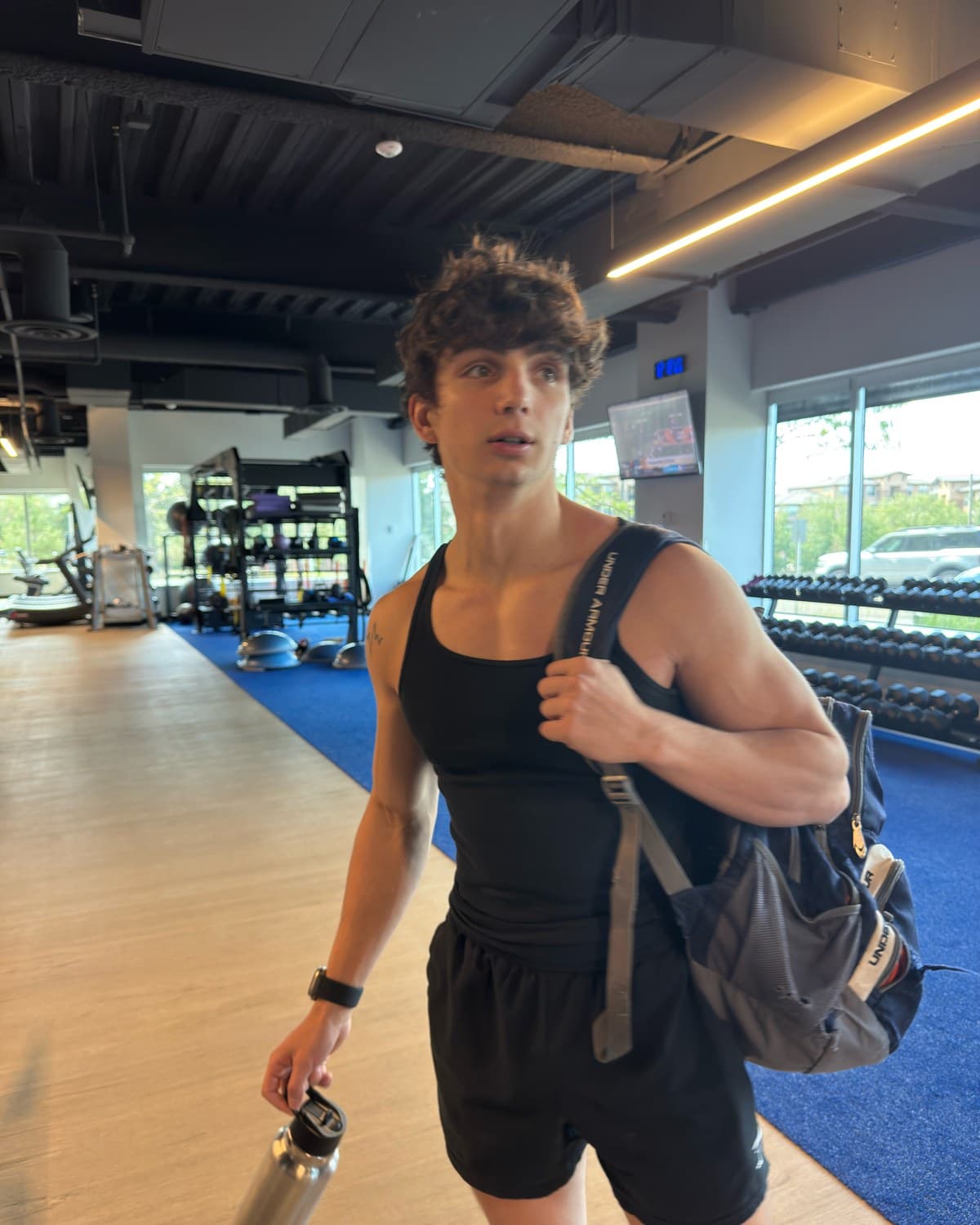
Kris Oddo, NASM-certified personal trainer, is the founder and head coach of Gains From Geebs (Geebs Coaching), a 1:1 online fitness coaching practice.
Guide
What does an online fitness coach actually do?
The short version: an online fitness coach writes your program, guides your nutrition, reviews your form by video, and holds you accountable between sessions — all delivered remotely. The longer version is what separates a real coach from a template farm, and that distinction is worth understanding before you pay for either.
Before you read on
The plan below works off your numbers. Get them first.
Protein targets and calories depend on your bodyweight, not an average. The calculator gives you both in about a minute, so the rest of this article is something you can actually follow.
Free coaching tip
Want a useful coaching tip before you go?
What does an online FITNESS coach do (vs a career coach or life coach)?
An online fitness coach works on your body — specifically training, nutrition, and physical accountability. The credential is typically a personal training certification (NASM-CPT, ISSA, ACE, or similar). The goal is physical: body composition, strength, fat loss, muscle building. A fitness coach is not a life coach (mindset, purpose, career direction) and not a career coach (professional advancement, job search, leadership). The word “coach” covers all three, which creates the confusion — but the disciplines, credentials, and scope of practice are completely separate. It is also not a registered dietitian; here is where a fitness coach ends and a nutritionist begins.
This page covers the fitness variety specifically: what a certified online fitness coach does day-to-day, what is included in the service, what separates a real coaching relationship from a template farm, and what a coach cannot do.
What an online fitness coach does day-to-day
At the start of coaching: a full intake — training history, limitations, equipment, schedule, goals — then a custom program built from scratch to where the client is today. Not a template modified to look custom. An actual program designed around that person's level, recovery capacity, and weekly constraints.
Day to day: an accountability check-in that covers training windows, nutrition questions, sleep, and any logistical problems with the week ahead. Clients send form videos; the coach reviews them and sends back specific cues before or between sessions. Questions get answered in real time through direct messaging.
Once a week: a review call that goes through every session of the past seven days — what happened, what the data showed, what adjusts. The program updates based on the review. The next week's targets are confirmed. Then it repeats.
What's included vs a fitness app
A fitness app gives you a program. A coach gives you a program that responds to what is actually happening in your life.
Apps do not adjust when your week falls apart. They do not catch that your form on Romanian deadlifts is loading your lower back instead of your hamstrings. They do not recalibrate your nutrition targets when your bodyweight has dropped enough that your maintenance calories have changed. They do not notice you missed three sessions and ask why.
What apps do well: structured programming at low cost, no scheduling required, good enough for self-motivated experienced lifters who primarily need a program to follow. For a full comparison, see 1:1 coaching vs fitness apps.
What a good coach does that a template farm does not
The coaching industry has a quality range problem. At the low end: a PDF program with a name on it, weekly “check-in” forms that no one reads, and a generic macro calculator. At the high end: a coach who knows your week, adjusts your program based on how you are actually recovering, and catches the patterns — nutrition drift, sleep degradation, form breakdown — before they become plateaus or injuries.
The distinguishing behaviors of a good coach: they watch your form videos themselves (not a team), they respond to daily check-ins with actual adjustments (not automated acknowledgments), and they update your program based on the data from the past week, not a preset cycle. The program you have in week eight should look meaningfully different from the one you started with, because the coach has seen eight weeks of your data.
For a checklist of what to verify before hiring a coach, see how to hire an online fitness coach.
Proof trail
What this looks like in practice
A real online coach should be easy to verify beyond generic promises. These examples show the result trail, public review trail, and coach-identity trail behind the daily-accountability claims on this page.
Tracked 16-week average
25 lb
Average fat loss across 15 completed clients tracked over 16 weeks. Individual results vary.
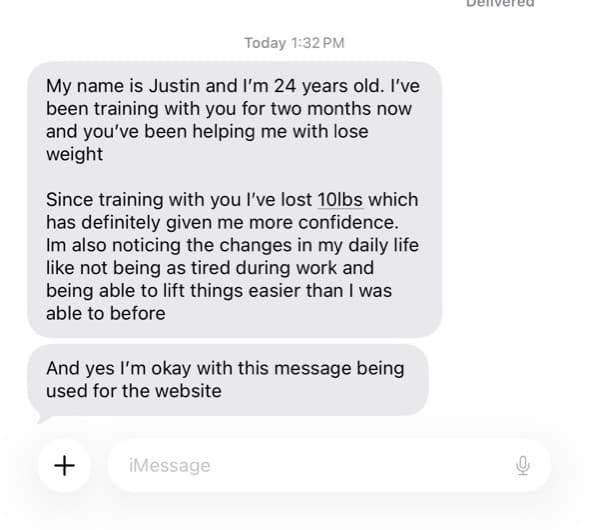
2 months - down 10 lb, more confidence, more energy
Down 10 pounds and carrying more confidence into daily life.
“I've lost 10 lb, which has definitely given me more confidence. I'm not as tired during work and I can lift things easier than before.”
Justin
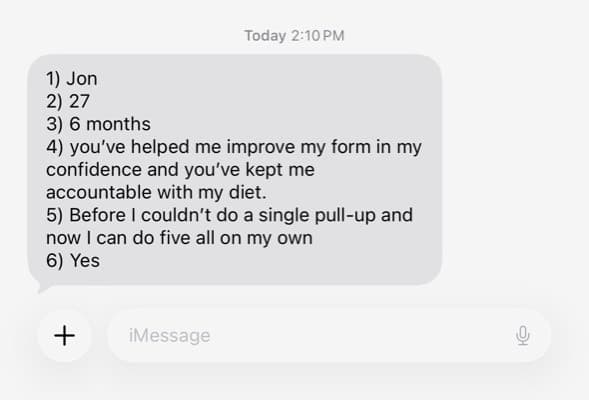
6 months - better form, diet accountability, 5 pull-ups
From zero pull-ups to five on his own.
“Before I couldn't do a single pull-up, and now I can do five all on my own.”
Jon Miller
Google review - 5/5
Public review mentioning Kris directly
“Great staff. Even greater experience. Would definitely recommend to anyone looking to improve themselves. Kris is the person you want to take it to that next level.”
Jake Ross - 11 months ago
Before you apply
Meet Kris before you decide.
Hear how Kris handles the application call, what he looks for, and how he decides whether 1:1 coaching is a fit.
Start your applicationWhat an online coach cannot do — the honesty section
An online fitness coach cannot guarantee results. The coach builds the conditions; the client executes. A coach who guarantees a specific transformation outcome in a specific time frame is selling something other than coaching.
Online coaching cannot replace medical care. A coach can program around old injuries and recommend conservative load progressions, but diagnosing injuries, managing chronic conditions, or prescribing any medical intervention is outside the scope of coaching. If you have a persistent injury, see a doctor or physio before starting a program.
Online coaching cannot do the work. Accountability and structure can dramatically improve consistency — the data on supervised vs self-guided training adherence shows a real gap. But the client has to show up, execute, and be honest about what is happening. A coach can build the best restart plan in the world for someone who is not actually ready to commit. It will not work.
How to tell if you actually need a coach
You probably do not need a coach if: you are already consistent, you have a solid program, you understand progressive overload and nutrition well enough to adjust on your own, and accountability is not the variable that has been failing you. In that case, a good program or app is likely sufficient.
You probably need a coach if: consistency is the main reason the previous approaches did not work; you have been training for a while and have stalled without knowing why; you are starting after a long break and want the ramp-up calibrated correctly; or you have enough complexity in your situation (travel, injuries, unpredictable schedule) that a static program reliably breaks down.
The test: if your honest answer to “have I been consistent for more than eight weeks straight?” is no — and the reason is internal, not an external event — that is the accountability gap coaching solves. For a fuller worth-it analysis, see is online fitness coaching worth it.
Related reading and paths
Common questions about working with an online fitness coach
- How often does an online fitness coach contact you?
- It depends on the coach and the package. At the more attentive end — which is what 1:1 coaching means — daily accountability check-ins and a weekly review call are standard. Daily contact covers training windows, nutrition questions, sleep, and recovery. Template-based services may only communicate weekly or less.
- Does an online fitness coach write a meal plan?
- A good one does not write a rigid meal plan — they set macro targets and build flexible nutrition habits around your actual eating patterns. Rigid meal plans fail in the real world because they require perfect conditions. Macro targets with practical food strategies work in restaurants, on travel days, and on weekends.
- How does an online coach check your form without seeing you in person?
- Video review. The client records sets and sends them through the coaching platform or direct message. The coach reviews and sends back specific cues — corrections based on what that client is actually doing in that movement, not generic tips. Most online coaches offer same-day or next-session feedback.
- What happens week to week with an online fitness coach?
- Week one: intake, assessment, program built from scratch to current level. Weeks two through six: daily accountability, training sessions executed, weekly review call covers how the week went and what adjusts. Months two and three: program progresses, nutrition targets refine based on real data, plateaus are diagnosed and corrected. Assessment → execution → review → adjust, repeated every week.
- Is it awkward to work with an online fitness coach you have never met?
- Less than most people expect. The coaching relationship is built through the work — daily check-ins, form review, weekly calls. It is conversational and task-focused. Most clients report feeling comfortable within the first week because the contact is practical and responsive, not evaluative.
FAQ
Quick questions
How often does an online fitness coach contact you?
It depends on the coach and the package. At the more attentive end — which is what 1:1 coaching means — daily accountability check-ins and a weekly review call are standard. Daily contact covers training windows, nutrition questions, sleep, and recovery. The weekly call reviews the past seven days workout by workout and adjusts what is coming next. Template-based coaching services may only communicate weekly or less.
Does an online fitness coach write a meal plan?
A good one does not write a rigid meal plan — they set macro targets and build flexible nutrition habits around your actual eating patterns. Rigid meal plans fail in the real world because they require perfect conditions. Macro targets with practical food strategies work in restaurants, on travel days, and on weekends. The coaching is about decisions and patterns, not following a PDF.
How does an online coach check your form without seeing you in person?
Video review. The client records sets and sends them through the coaching platform or direct message. The coach reviews and sends back specific cues — not generic technique tips, but corrections based on what that client is actually doing in that movement. Most online coaches offer same-day or next-session feedback. Form review via video catches real-world movement patterns more accurately than gym mirrors.
What happens week to week with an online fitness coach?
Week one: intake, assessment, program built from scratch to current level. Weeks two through six: daily accountability, training sessions executed, weekly review call covers how the week went and what adjusts. Months two and three: program progresses, nutrition targets refine based on real data, plateaus are diagnosed and corrected. The pattern is assessment, execution, review, adjust — repeated every week for as long as coaching runs.
Is it awkward to work with an online fitness coach you've never met?
Less than most people expect. The coaching relationship is built through the work — daily check-ins, form review, weekly calls. It is conversational and task-focused, not clinical. Most clients report feeling comfortable within the first week because the contact is practical and responsive, not evaluative.
See it from the inside
The best way to understand what coaching actually involves is to see how Kris runs it. Read the full coaching methodology or the Geebs Method overview. The application is three questions, under two minutes — the strategy call is where the real conversation about fit happens.
Come back tomorrow
A guide answers one question. The habit is what changes your body.
You have the answer you came for. Staying on track is the daily part — so we publish one evidence-based training and nutrition finding every day, plus a weekly email that keeps the useful stuff in front of you.
Free coaching tip
Want a useful coaching tip before you go?