In this guide
- Gym anxiety is normal — say that first
- The spotlight is in your head
- What gym anxiety actually is
- How to get past the fear of the gym
- Most of it is competence, not courage
- It fades — faster than you think
- Why structure kills it
- Honest limits
- FAQ
Gym anxiety is normal — say that first
If walking into a gym makes you tense — certain everyone is watching, certain you'll do something wrong, certain you don't belong there — you are not unusual. Gym anxiety is extremely common, and it hits men starting out, and men starting over, hardest.
It rarely gets said out loud. Admitting you're nervous about a gym feels like it should be beneath a grown man, so men carry it quietly — and a lot of them just don't go. The anxiety wins by never being named.
So name it. It's a normal, common feeling, not a character flaw. And it's beatable with a few specific moves — not a personality transplant, not years of work. The rest of this is the moves.
The spotlight is in your head
At the core of gym anxiety is the spotlight feeling: everyone is watching you, everyone is clocking that you don't belong, someone is ready to judge a bad rep.
They are not. Almost everyone in a gym is focused entirely on themselves — their own set, their own phone, their own playlist, their next exercise. A gym is one of the least observant rooms you will ever stand in. People there are self-absorbed, in the completely harmless sense of the word.
The other false story is that everyone else is a confident regular who has always belonged. Gyms are full of beginners, of people having flat, mediocre days, of men who were exactly as nervous as you a year ago. The room is far more like you than it looks from the door.
What gym anxiety actually is
It helps to name which flavor you have, because they have different fixes. For most men it's a mix of three.
Fear of judgment — the spotlight feeling above. Competence anxiety — not knowing what to do: which machine, how many sets, what comes next. And body-image discomfort — the feeling that you should already be in shape before you're allowed to work on being in shape, which is exactly backwards.
In exercise science, that body-image discomfort is studied as social physique anxiety. Work by Portman and colleagues (2018) investigated how social physique anxiety connects with actual training behavior among 33 male and 31 female active members of an on-campus university gym (PMID 29320305). Participants completed a background physical activity questionnaire along with the nine-item Social Physique Anxiety Scale, and performed an exercise session at a self-selected exertion level with intensity recorded via heart rate monitor. Portman and colleagues observed that social physique anxiety was not associated with physical activity frequency, history of exercise (measured by duration of gym membership), or workout intensity in either male or female exercisers. While female participants reported higher overall social physique anxiety and favored higher-intensity aerobic exercise, male participants showed a distinct preference for anaerobic physical activity like lifting. Most importantly, the researchers concluded that experiencing social physique anxiety does not deter body-conscious individuals from performing regular physical activity, and that differences between men and women in physique anxiety are not linked to differences in how physical activity is performed. Feeling self-conscious about your body does not stop you from building a consistent training routine once you show up.
Much of this discomfort is fueled by unrealistic physical ideals that men absorb from media and commercial culture. In an investigation of 251 Swedish participants in fitness center activities (85 men and 166 women), Eriksson and colleagues (2008) examined how scores on the Social Physique Anxiety Scale and the Sociocultural Attitudes Towards Appearance Questionnaire relate to exercise patterns and member self-image (PMID 18067519). The authors noted that fitness centers could make a point of emphasizing that some physical ideals are neither healthy nor realistic, thus strengthening member self-image and preventing social physique anxiety, eating disorders, and negative attitudes toward appearance. Recognizing that commercial physique standards are artificial and often unrealistic helps take the pressure off: you do not need to look like a fitness model to belong on the gym floor.
For most men, the honest breakdown is that it's mostly the second one — competence anxiety — wearing the costume of the first. You think you're afraid of being judged. You're really afraid of being visibly lost. That distinction is the whole key, and the next sections use it.
How to get past the fear of the gym
Concrete moves that actually work, in order of leverage.
Go at off-peak times first. Mid-morning or early afternoon on a weekday — a near-empty gym removes most of the spotlight instantly. Build the habit in the quiet hours; once it's a habit, peak hours stop mattering.
Walk in with a written plan. Exact exercises, sets, reps, in order, on your phone. Most gym anxiety lives in the specific moment of standing still, unsure what's next — a written plan deletes that moment entirely.
Start with machines. They have instructions printed on them, they guide the movement so there's less to do wrong, and the machine area feels far less exposed than the free-weight floor. Graduate to barbells once the gym feels normal.
Headphones on, and give it five to eight visits before you judge it. The very first visit is the worst it will ever feel. By the fifth, it's mundane — and mundane is the goal.
Most of it is competence, not courage
Worth stating plainly: most gym anxiety is not really fear of the gym. It's fear of being visibly lost in the gym. Those are different problems that happen to share a symptom.
You are not actually anxious about doing a squat. You're anxious about not knowing whether you're doing it right, while you imagine being watched doing it wrong. Remove the uncertainty and most of the fear loses its grip.
That is why a written plan helps so much, and why the anxiety fades so fast once you have one. When you know exactly what you're doing, there is simply nothing left to be visibly lost about. It isn't a courage problem. It's an information problem.
It fades — faster than you think
Gym anxiety responds to exposure better than almost any other kind of nervousness. You do not have to think your way out of it. You have to walk in a handful of times and let it become boring.
Within a few weeks the gym goes from a threat, to a routine, to honestly kind of dull. That is exactly the outcome you want. Dull means it has stopped costing you anything to go — which means you'll keep going.
And every confident regular in that room was once the nervous guy at the door. None of them were born belonging there. They just kept showing up until they did.
Why structure kills it
The single most reliable fix for gym anxiety is a real program — because a program means you always know exactly what to do, every set, every visit. No standing still, no guessing, no being visibly lost. The competence anxiety that was most of the problem simply has nowhere left to live.
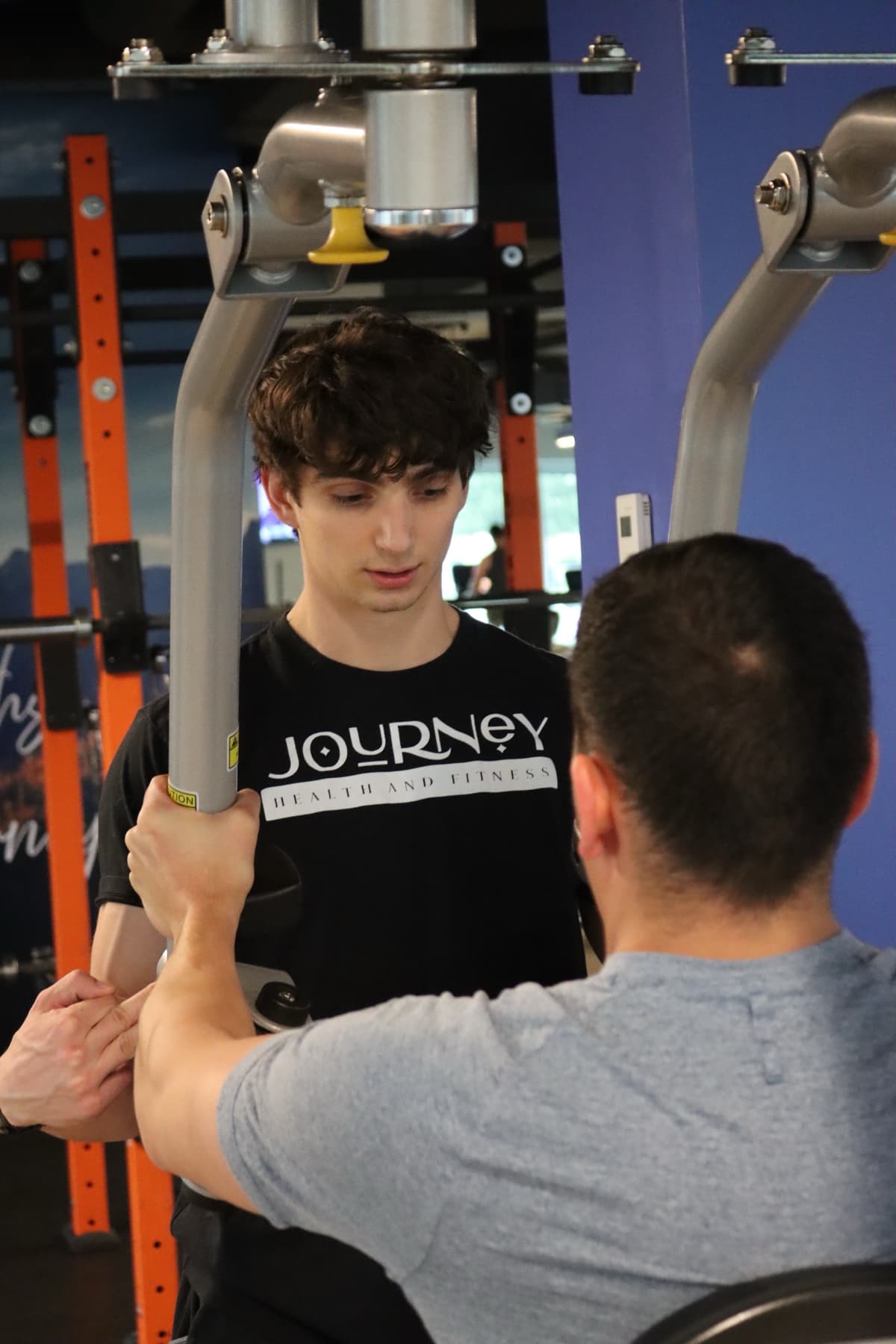
That is a quiet, genuine benefit of coaching that rarely gets mentioned: you walk in with the entire session already decided. For a man fighting gym anxiety, that certainty is worth nearly as much as the programming itself.
It pairs with the other hard part — actually keeping it going once the nerves fade. That's the staying-consistent problem, and it's what Kris coaches men 25-40 through. If you prefer to train at home or want a structured transition to the gym, see online fitness coaching for men who hate the gym.
Honest limits
- Active university gym cohort: The investigation by Portman and colleagues (2018) examined 33 male and 31 female participants who were already active users of an on-campus university gym (PMID 29320305). While the researchers found that social physique anxiety was not associated with workout frequency, exercise history, or session intensity, men who are completely new or restarting after a long layoff may experience higher initial apprehension than established members.
- Cross-sectional survey design: In the study of 251 fitness center attendees (85 men and 166 women) by Eriksson and colleagues (2008), data were collected via the Social Physique Anxiety Scale, the Sociocultural Attitudes Towards Appearance Questionnaire, and self-reported exercise metrics (PMID 18067519). Self-report surveys identify associations between attitudes and behavior, but longitudinal studies tracking guided gym onboarding over time are needed to measure how rapidly anxiety decreases with repeated exposure.
- Separating physique anxiety from competence: Both Portman and colleagues (2018) and Eriksson and colleagues (2008) addressed social physique anxiety and appearance concerns. However, much of men's gym hesitancy stems from procedural uncertainty—not knowing how to adjust machines, select weights, or run a progression. Overcoming gym anxiety requires practical workout structure alongside healthier perspectives on body image.