Free tool
Body recomp calculator
This body recomposition calculator tells you whether building muscle and losing fat at the same time is realistic for your starting point. Enter your stats to get a recomp viability read, daily calorie goal, protein target, and a realistic 12-week expectation. Free, no signup, no email gate.
Updated · Written by Kris Oddo, NASM-CPT
What the calculator provides
Calories, protein, and whether recomp is the right phase
The calculator estimates your maintenance calories with Mifflin-St Jeor, sets a conservative recomp calorie target, gives a daily protein goal, then tells you whether you are a strong, possible, or unlikely body-recomposition candidate based on body fat, training age, and planned training days.
Best fitBeginners, returners, and higher-body-fat lifters.
Usually not idealVery lean or already-trained lifters chasing faster muscle gain.
Next stepUse the result to choose recomp, cut, lean bulk, or coaching.
After the calculator
Turn your result into a two-week starting plan
Keep the calorie and protein target unchanged for two weeks, lift three times, and record a daily weigh-in plus one waist measurement each week. Then use the trend — not one day of scale noise — to decide whether anything needs adjusting.
Body recomposition calculator for women
How does the calculator work for women?
Choose Female and the calculator changes two things. It estimates your maintenance calories with the female version of Mifflin-St Jeor, which subtracts 161 calories where the male version adds 5, and it judges your recomp chances on female body-fat ranges. A woman new to lifting at 22% body fat or more, or returning after a break at 20% or more, gets a strong-candidate verdict.
The training side does not change. Roberts and colleagues pooled studies that put men and women on the same lifting program and found no reliable difference in muscle growth, with women gaining more relative upper-body strength (2020, PMID 32218059). Same lifts, same progressive overload, same protein per pound.
Why the scale may not move for women on a recomp
In a 10-week trial, the group eating at maintenance with high protein lost 1.41 kg of fat and gained 0.97 kg of fat-free mass, so body weight barely changed while body composition did (Vargas-Molina et al., 2026, PMID 41940947). Many women also see water swings around their period. Track a weekly average weight, your waist and your lifts for four weeks before you change the calorie target, and see online fitness coaching for women if you want Kris to adjust it with you.
Direct answer
What does a body recomp calculator tell you?
A useful body recomposition calculator gives you four answers: estimated maintenance calories, a modest recomp calorie target, a daily protein target, and whether your starting point makes recomp realistic. This calculator uses Mifflin-St Jeor for maintenance, applies a 12% deficit, sets protein at 0.8–1.0 grams per pound of bodyweight, then reads body fat, training history, and weekly lifting days before recommending recomp, a focused cut, or a lean bulk.
Formula: BMR from Mifflin-St Jeor × activity multiplier = estimated TDEE; recomp calories start at about 88% of TDEE.
Protein: most recomp candidates start around 0.9 g/lb; already-lean or unlikely recomp cases start closer to 0.8 g/lb.
Decision rule: beginners, returners, and lifters with enough body fat are better recomp candidates; very lean or advanced lifters usually need a clearer cut or lean-bulk phase.
Calculator formula
How does the calculator set your calories and protein?
The body recomp calculator follows one sequence: estimate BMR with Mifflin-St Jeor, multiply by training-day activity, set recomp calories at 88% of that maintenance estimate, set protein from bodyweight, then use body fat and lifting history to decide whether recomp is the right phase.
Example: a 190 lb, 5’10”, 30-year-old man lifting 3 days per week with 20% body fat lands near 2,834 maintenance calories, 2,493 recomp calories, and 171 g protein. The calculator marks that profile as a strong recomp candidate because he is new to structured lifting and has enough stored body fat to support a modest deficit.
Quick answer
Does height change your recomp calories?
Height is a direct input to the Mifflin-St Jeor equation that powers this calculator. For males, BMR = 10 × weight (kg) + 6.25 × height (cm) − 5 × age + 5. A 6’0” (183 cm) man has a materially higher maintenance calorie number than a 5’7” (170 cm) man at the same weight and age — that difference flows through directly to your recomp calorie target and protein goal. Enter your actual height, not a rough estimate, so the starting numbers are accurate before week one. This is how Kris Oddo, NASM-CPT, approaches client intake at Geebs Coaching — real inputs produce real targets, not generic app defaults.
Where do the calculator’s numbers come from?
TDEE is calculated via the Mifflin-St Jeor equation — the most validated BMR formula for the general population (Mifflin et al., 1990). BMR = 10 × weight (kg) + 6.25 × height (cm) − 5 × age + 5 (male) or − 161 (female). TDEE multiplies BMR by an activity factor derived from your weekly training days (1.375 for 1–2 days, 1.55 for 3–4, 1.725 for 5, 1.9 for 6).
The recomp calorie target applies a 12% deficit to TDEE — within the 10–15% range that research identifies as the sweet spot for simultaneous fat loss and muscle-building. Below 10% and the body prioritizes muscle before fat. Above 20% and training quality degrades. Protein is set at 0.9 g/lb (0.8 g/lb if recomp is unlikely) per ISSN guidance (Jäger et al., 2017).
The viability judgment uses training experience and body fat estimate as primary signals. Beginners and returning lifters have a genuine physiological advantage — untrained or re-trained muscle grows faster in response to novel stimulus, even in a deficit. Trained, already-lean individuals face diminishing returns from simultaneous recomp.
How accurate is a body recomp calculator?
These numbers are starting estimates, accurate to roughly ±10%. TDEE calculators estimate — they do not measure. Individual variation in metabolism, training intensity, sleep, and stress all affect real calorie needs. Run the targets for 3–4 weeks, then adjust based on what your mirror, measurements, and strength logs actually show.
No promised numbers for lb of fat lost or muscle gained — those depend on execution, sleep, consistency, and starting point. What is reliable: beginners following high-protein near-maintenance training consistently for 12 weeks will see real changes in body composition and strength.
Put the numbers to work
What should you do with your result in the first three weeks?
Pick the calorie and protein targets the calculator gives you, then make the first three weeks boring. Keep meals, training days, and weigh-in conditions consistent enough that you can tell what the plan is doing. Changing calories every time the scale bumps up or down turns a useful starting point into guesswork.
1. Set the floor
Hit the protein target daily and log your morning bodyweight under the same conditions when you can.
2. Train to progress
Use a repeatable lifting plan and write down your sets, reps, and loads so strength has a chance to tell its side of the story.
3. Review the trend
After three weeks, compare your weight trend, waist measurement, photos, and gym log before making one small adjustment.
A flat scale does not settle the question by itself. If your waist is coming down while your lifts are stable or improving, stay with the plan long enough to collect another week of data. If every signal has stalled, adjust one variable at a time so you know what helped.
Next steps by result
What does your recomp verdict mean?
Your viability classification indicates whether your body can build muscle while losing fat efficiently, or whether a dedicated cut or lean bulk will produce faster results.
Strong candidate: New or returning lifter with fat to lose
What to do: Eat at your calculated recomp calories and hit your daily protein. Follow a progressive strength routine 3–4 days per week.
Best next step: Read our beginner body recomposition guide to set up your training splits and progression rules, follow the full body recomposition program for men, or get a target date from the free body recomposition forecast.
Possible candidate: Intermediate lifter or moderate body fat
What to do: Keep your deficit conservative (10–12%) and judge progress by gym performance and waist measurements rather than rapid scale drops.
Best next step: Use the recomp macros resource to balance carbs and fats around your training sessions.
Better alternative: Already lean or advanced lifter
What to do: Simultaneous recomp delivers diminishing returns when lean. If you want more muscle, eat in a slight surplus (+200–300 kcal). If you want to lose fat, run a focused 8–12 week cut.
Best next step: Check your maintenance level with the TDEE calculator or consider 1:1 coaching for individualized programming.
Measuring progress
How do you know recomp is working if the scale is flat?
When you build muscle and lose fat at the same time, the bathroom scale can stay unchanged for weeks. Relying solely on scale weight leads many lifters to abandon a working plan prematurely. Track these three objective signals instead:
1. Navel waist circumference decreases
Measure around your waist at the level of your belly button once a week under identical morning conditions. When your waist measurement decreases while your bodyweight stays flat, abdominal and visceral fat is reducing while lean muscle tissue is preserved or growing.
2. Compound strength holds or progresses
Log your working sets, repetitions, and weights across your primary compound exercises. In a steep calorie deficit, strength typically drops. If your strength across 3–4 weekly lifting sessions holds steady or increases over 4–6 weeks, your calorie deficit is conservative enough to support muscle tissue.
3. Standardized monthly progress photos show shape changes
Take front, side, and back photos every 4 weeks using consistent lighting and framing. Visual changes in abdominal tightness and shoulder definition often become clearly apparent between weeks 8–12 even when your morning bodyweight has barely moved.
Training guidance
How much lifting and cardio should you do while recomping?
Your calculator targets set the nutritional foundation, but training is what directs those calories toward muscle building rather than fat storage. Balance your training around two clear priorities:
Prioritize lifting 3–4 days per week
Progressive resistance training provides the mechanical tension required to signal muscle growth. Center sessions around compound exercises like presses, squats, hinges, and rows with consistent progressive overload.
Keep cardio low-impact and moderate
Treat cardio as a health and recovery support rather than a method to burn off calories. Daily walking or light conditioning supports expenditure without generating excess fatigue that detracts from your primary lifting sessions.
Macronutrient balance
How should you split carbs and fat after protein?
Once your protein floor is secured at 0.8–1.0 g/lb, distribute your remaining daily calories between dietary fats and carbohydrates to maximize recovery and performance:
Maintain a dietary fat baseline of 0.3–0.4 g/lb
Dietary fats are vital for hormone production and joint recovery. Setting dietary fats to approximately 20–25% of total calories ensures essential fatty acid intake without taking away from the energy needed for lifting sessions.
Allocate remaining calories to complex carbohydrates
Carbohydrates fuel high-tension strength training and restore muscle glycogen. Eating complex carbs around your training window helps preserve lifting intensity even while in a slight calorie deficit.
Progressive adjustments
When should you change your recomp calories?
Run your calculator numbers consistently for 4 weeks before changing any variables. If an adjustment is warranted after evaluating your weekly trend data, follow these guidelines:
If weight drops faster than 1.5 lbs per week: Add 100–150 calories
A rapid scale drop indicates the calorie deficit is too aggressive, risking muscle loss. Add 100–150 daily calories (primarily from carbohydrates) to slow the rate of loss and protect your lean muscle tissue.
If waist and lifts are completely flat after 6 weeks: Make one small adjustment
If your navel waist measurement, gym numbers, and scale weight show zero change after 6 consistent weeks, your current intake is matching maintenance. Reduce daily intake by 100–150 calories or increase daily steps by 1,500–2,000 steps while keeping your protein target constant.
Related tools and guides
FAQ
Quick questions
How does height affect body recomposition calculations?
Height is used directly in the Mifflin-St Jeor BMR formula: BMR = 10 × weight (kg) + 6.25 × height (cm) − 5 × age + 5 for males. A taller man at the same bodyweight and age will have a higher BMR and therefore a higher TDEE and recomp calorie target. A 6'0" (183 cm) man burns roughly 80–100 more calories per day at rest than a 5'7" (170 cm) man of equal weight and age. That difference flows directly into your recomp calorie target — enter your actual measured height for the most accurate result.
Is there a body recomposition calculator for women?
Yes. Choose Female in the calculator, or open it from the women's link, and it uses the female Mifflin-St Jeor formula (minus 161 instead of plus 5) and female body-fat ranges to judge whether recomp suits you. A woman new to lifting at 22% body fat or more, or returning to lifting at 20% or more, gets a strong-candidate verdict. You get a daily calorie target, a protein target of 0.8 to 0.9 g per pound, and a 12-week expectation.
Can you build muscle and lose fat at the same time?
Yes — this is called body recomposition. It works most reliably for newer lifters (under 12 months of consistent training), people returning after a break, and those with sufficient body fat to fuel new muscle growth even in a slight calorie deficit. Advanced, already-lean athletes have a much narrower recomp window and typically get better results from dedicated cut or bulk phases.
How many calories should I eat for body recomposition?
A 10–15% deficit below your TDEE (Total Daily Energy Expenditure) is the standard recomposition target. This is enough of a deficit to draw on stored fat while keeping training fueled and muscle-building possible. The calculator uses the Mifflin-St Jeor equation to estimate TDEE, then applies a ~12% deficit as the starting recomp calorie target. Adjust based on 3–4 weeks of real trend data.
How much protein do I need for body recomposition?
0.8 to 1.0 grams per pound of bodyweight per day. The International Society of Sports Nutrition Position Stand (Jäger et al., 2017) supports 1.4–2.0 g/kg (roughly 0.6–0.9 g/lb) for general resistance training, with the upper end appropriate during a fat-loss phase. This calculator uses 0.9 g/lb for recomp candidates as a practical middle target. Hit protein before adjusting anything else.
How long does body recomposition take?
Strength and performance changes appear within 4–6 weeks. Visible body composition changes typically become noticeable around 8–12 weeks for beginners. The scale often stays flat or moves slowly — this is correct. Recomposition is measured by the mirror, measurements, and strength logs, not primarily by weight. Realistic timelines are 3–6 months for meaningful change in beginners; slower for trained athletes.
Who should not do body recomposition?
Very lean individuals (under 10% body fat for men, under 18% for women) generally do not have enough fat reserves to fuel muscle-building in a deficit — a lean bulk is more appropriate. Highly trained athletes (2+ years of consistent lifting) also see slower recomp returns and often produce better results from phased cutting and bulking cycles. This calculator flags these cases with an honest recommendation.
What should I do if my weight does not change during body recomposition?
A flat bathroom scale is standard during successful body recomposition. If your bodyweight remains unchanged over 4–6 weeks while your waist circumference at the navel drops and your strength logs on compound lifts increase, you are gaining muscle while losing fat at similar rates. Keep following your daily calorie and protein targets for at least 8–12 weeks before evaluating whether to adjust calories or switch phases.
Should I do cardio while doing body recomposition?
Keep progressive resistance training 3–4 days per week as your foundation. Cardio should be kept moderate and low-impact, such as daily walking, so it does not interfere with lifting recovery or cause unnecessary muscle breakdown. Your calorie target already creates the deficit needed for fat loss, so excessive cardio is unnecessary and often counterproductive.
Why does the calculator recommend a 10–15% deficit instead of a larger cut?
A conservative 10–15% deficit provides enough energy restriction to draw on stored body fat while preserving the training performance and protein synthesis required to build or maintain muscle. Deficits greater than 20% degrade training quality and recovery, which shifts weight loss away from fat and toward muscle tissue.
How should I allocate carbs and fats after hitting my protein target?
Once you secure your daily protein target (0.8–1.0 g/lb), set dietary fat at a baseline of 0.3–0.4 g/lb (around 20–25% of total calories) to support hormonal health and joint recovery. Allocate the remaining daily calories to carbohydrates to fuel lifting intensity and support glycogen stores during resistance training.
When should I adjust my body recomposition calorie target?
Keep your starting calorie numbers unchanged for the first 4–6 weeks to collect clean baseline data. If you are dropping more than 1–1.5 lbs per week, increase daily intake by 100–150 calories from carbohydrates to prevent muscle loss. If your waist measurement, scale weight, and gym strength are all completely unchanged after 6 weeks, reduce daily intake by 100–150 calories or add 1,500 daily steps.
Can I do body recomposition with dumbbells or home workouts?
Yes. Muscle tissue responds to progressive mechanical tension, not specific gym machinery. As long as your home or dumbbell sessions apply progressive overload—by adding repetitions, using heavier dumbbells, or increasing time under tension near muscular fatigue across compound movements—the stimulus for recomposition remains fully effective.
The calculator is the easy part
The numbers take 90 seconds. The hard part is weeks 3 through 12 — reading your weight trend, adjusting protein when life gets busy, keeping training progressive when motivation drops, and knowing what a flat scale actually means for your composition. That is what 1:1 coaching with Kris is for.
Coaching scholarship
30 days of free 1:1 coaching with Kris.
Up to 3 scholarships are open. Titan Forge runs a 30-day coaching intensive and Kris is one of the two coaches, alongside Steve Ginevan, PhD. You get weekly 30-minute coach check-ins and a plan shaped around your progress.
- · Applying is free. It takes about 3 minutes.
If you are selected, a $50 deposit holds your spot. No payment is collected in the application form.
Not sure the scholarship is the right route? Five ways to get coached when you cannot afford a trainer compares every option, including the free ones.
Come back tomorrow
One number today. The habit is what changes your body.
A calculator gives you a target once. Staying on track is the daily part — so we publish one evidence-based training and nutrition finding every day, plus a weekly email that keeps the useful stuff in front of you.
Free coaching tip
Want a useful coaching tip before you go?
25 lbAverage fat loss across 15 completed clients tracked over 16 weeks. Individual results vary.
1 of 3
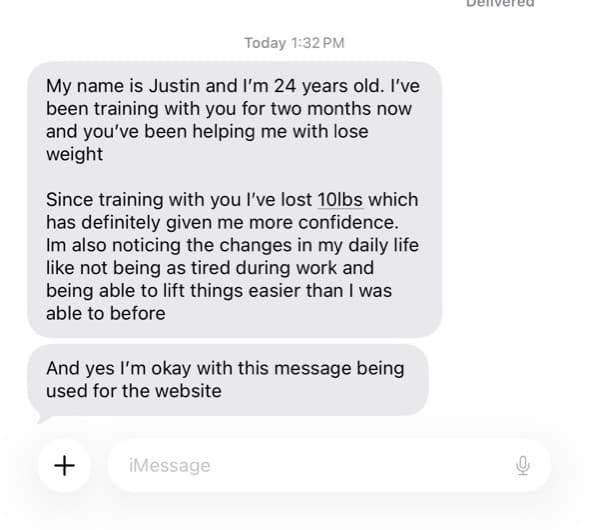 2 months coached
Down 10 pounds and carrying more confidence into daily life.
Justin · 24 · 2 months coached“I've lost 10 lb, which has definitely given me more confidence. I'm not as tired during work and I can lift things easier than before.”
See the full story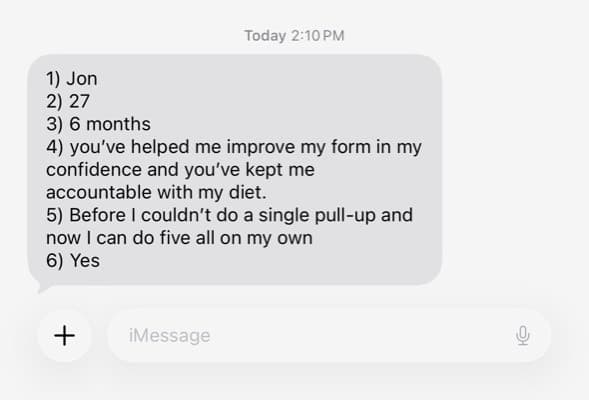 6 months coached
From zero pull-ups to five on his own.
Jon Miller · 27 · 6 months coached“Before I couldn't do a single pull-up, and now I can do five all on my own.”
See the full story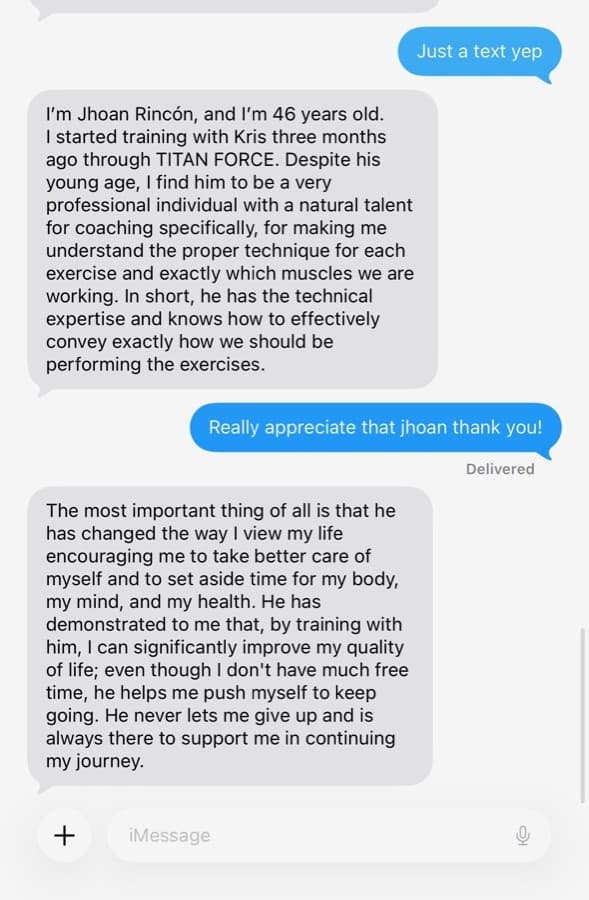 3 months coached
Better technique, better health, and support to keep going.
Jhoan Rincon · 46 · 3 months coached“Kris changed the way I view my life. Even though I do not have much free time, he helps me push myself to keep going and never lets me give up.”
See the full storyWays to work with Kris
Pick the one that fits your week.
You have read the argument. These are the options, and whichever one you pick carries into the application.
1 of 5
 Most hands-onYou want a coach on training, food and accountability every day.
- Daily replies, usually within the hour
- FaceTime meal prep: cook, portion, freeze the week
- Fully custom plan with Kris's own demo videos
 Core 1:1You want a coach with you daily, without the concierge layer.
- Custom training plan with demo videos
- Macros-based nutrition, no rigid meal plan
- Daily accountability at standard priority
 New, self-drivenYou run your own week and want a coach reading the numbers.
- Custom training and nutrition plan
- One recorded Loom review of your week
- Adjustments based on what the week showed
 One-time guidanceYou want direction now without a monthly commitment.
- A focused 45-minute Zoom with Kris
- A real diagnosis of what is holding back progress right now
- Guidance on training, nutrition, accountability, or schedule
 Community membershipYou want a serious fitness community without a coaching contract.
- Access to the Titan Forge Science-Based Telegram community
- Training, nutrition, recovery, and research discussion
- Shared accountability with like-minded lifters