Free tool
Calorie deficit calculator
Find your maintenance calories, then a mild, standard, or aggressive deficit target — each with the fat loss it projects per week. Built for clients who want a practical starting point. No signup. No email gate.
How it works
The calculator finds your BMR with the Mifflin-St Jeor equation, multiplies by an activity factor for your TDEE (maintenance), then subtracts a deficit: 250, 500, or 750 calories. Projected weekly loss assumes roughly 3,500 calories per pound of fat.
These are starting estimates, accurate to about ±10%. Run a deficit for 2-3 weeks, then adjust to your actual weight trend — losing faster than projected, eat a little more; flat, trim a little. The calculator points the direction; your trend confirms the number.
Related tools and guides
FAQ
Quick questions
What is a calorie deficit?
A calorie deficit means eating fewer calories than your body burns in a day. It is the underlying mechanism of all fat loss — when intake is below expenditure, the body makes up the difference from stored energy, including body fat. Paired with resistance training and adequate protein, that lost weight comes predominantly from fat.
How big should my calorie deficit be?
For most men, 250 to 500 calories below maintenance per day — a mild to standard deficit — is the sustainable range. A 750-calorie aggressive deficit can be used for short stretches, especially at higher body fat, but it is harder to sustain and risks muscle loss. Never sit below your BMR for sustained periods.
How much weight will I lose in a calorie deficit?
Roughly one pound of fat per 3,500-calorie cumulative deficit. So a 500-calorie daily deficit projects to about 1 pound per week, 250 per day to about 0.5 pound, and 750 per day to about 1.5 pounds. These are estimates — actual loss varies, so adjust based on a 2-3 week weight trend.
Is a bigger calorie deficit faster?
Faster on the scale, but not better. Too aggressive a deficit strips muscle along with fat, tanks training performance, and is very hard to sustain — which usually ends in regain. A moderate deficit you can hold for months reaches a better, more lasting result than a steep one you quit. Steady is the genuinely fast route.
Why am I not losing weight in a calorie deficit?
Usually the deficit is smaller than you think — untracked calories from oils, drinks, bites, and weekend meals quietly close the gap. It can also be normal 1-2 week fluctuation from water and food volume. Track intake honestly, judge by a 2-3 week weight trend rather than day to day, and recalibrate if the trend is flat.
Want a coach to calibrate the deficit for you?
The number is the easy part. The work is the weekly adjustment — reading your weight trend, training, sleep, and stress, then knowing what to change so you lose fat without losing muscle. That is what 1:1 coaching with Kris is for.
Come back tomorrow
One number today. The habit is what changes your body.
A calculator gives you a target once. Staying on track is the daily part — so we publish one evidence-based training and nutrition finding every day, plus a weekly email that keeps the useful stuff in front of you.
Free coaching tip
Want a useful coaching tip before you go?
25 lbAverage fat loss across 15 completed clients tracked over 16 weeks. Individual results vary.
1 of 3
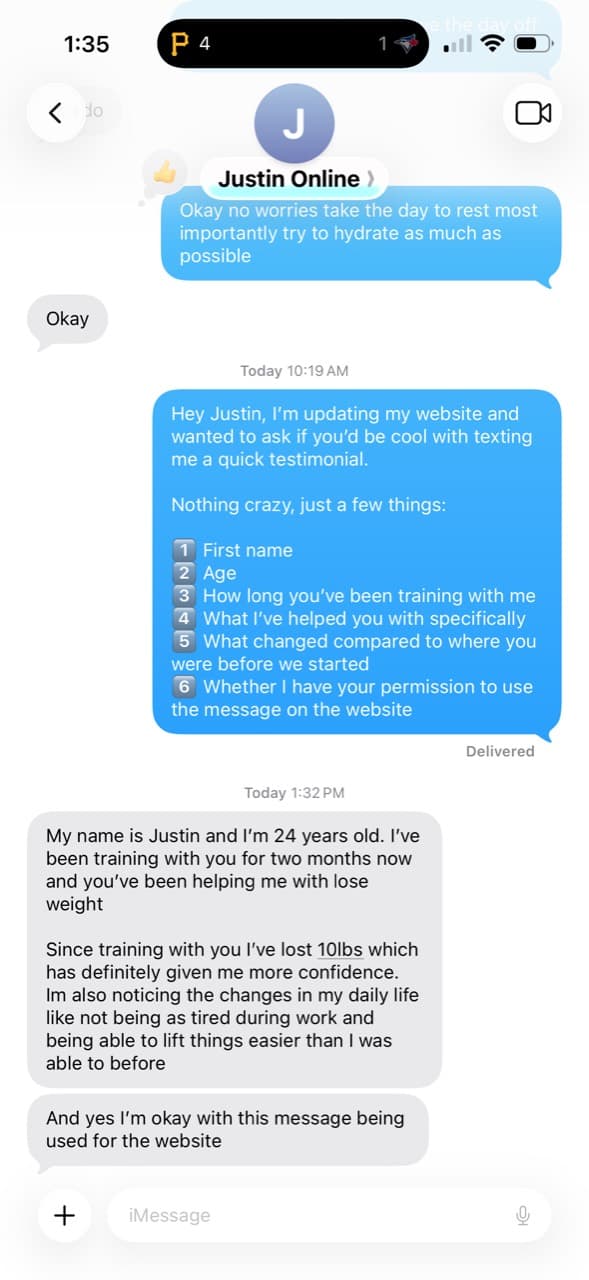 2 months coached
Down 10 pounds and carrying more confidence into daily life.
Justin · 24 · 2 months coached“I've lost 10 lb, which has definitely given me more confidence. I'm not as tired during work and I can lift things easier than before.”
See the full story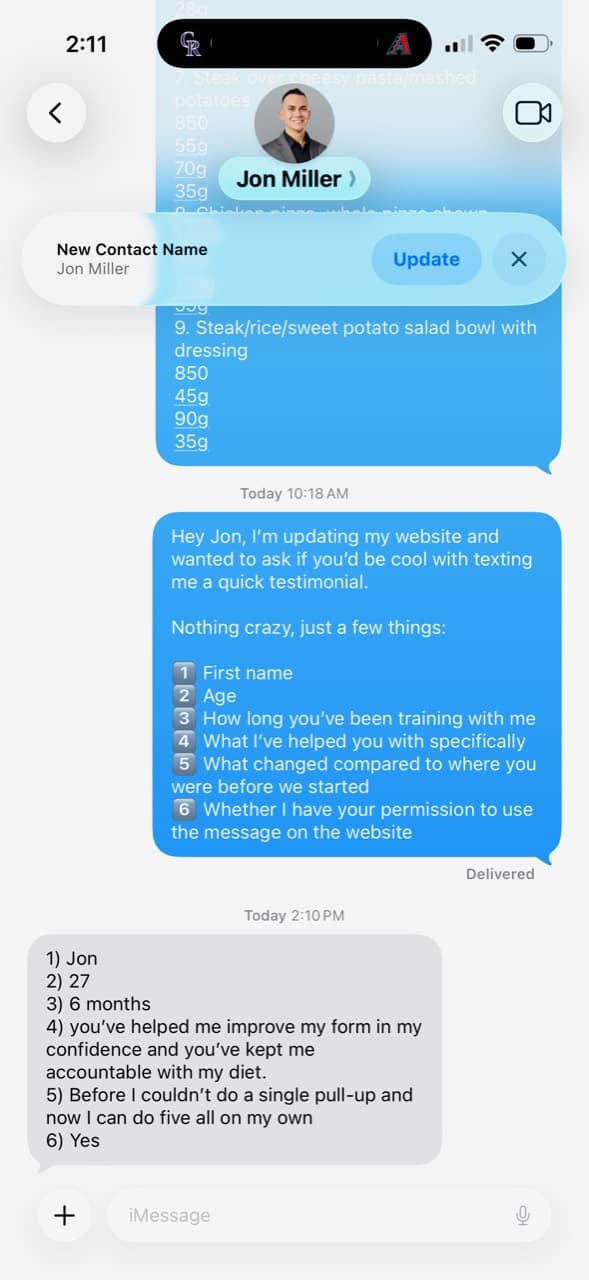 6 months coached
From zero pull-ups to five on his own.
Jon Miller · 27 · 6 months coached“Before I couldn't do a single pull-up, and now I can do five all on my own.”
See the full story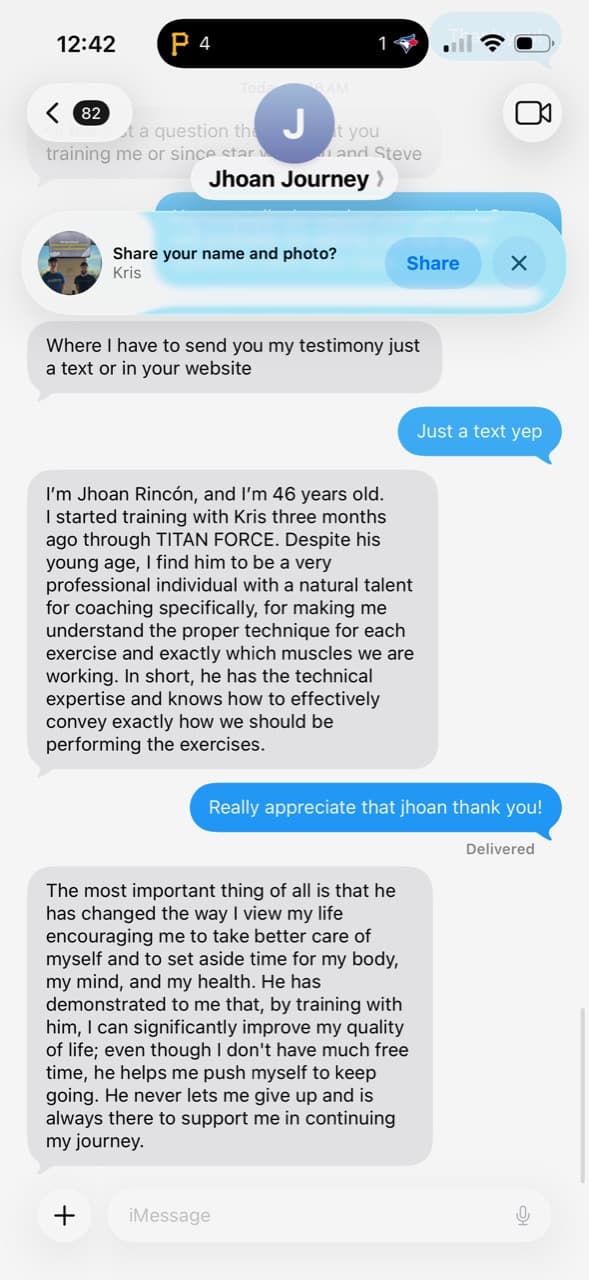 3 months coached
Better technique, better health, and support to keep going.
Jhoan Rincon · 46 · 3 months coached“Kris changed the way I view my life. Even though I do not have much free time, he helps me push myself to keep going and never lets me give up.”
See the full storyWays to work with Kris
Pick the one that fits your week.
You have read the argument. These are the options, and whichever one you pick carries into the application.
1 of 5
 Most hands-onYou want a coach on training, food and accountability every day.
- Daily replies, usually within the hour
- FaceTime meal prep: cook, portion, freeze the week
- Fully custom plan with Kris's own demo videos
 Core 1:1You want a coach with you daily, without the concierge layer.
- Custom training plan with demo videos
- Macros-based nutrition, no rigid meal plan
- Daily accountability at standard priority
 New, self-drivenYou run your own week and want a coach reading the numbers.
- Custom training and nutrition plan
- One recorded Loom review of your week
- Adjustments based on what the week showed
 One-time guidanceYou want direction now without a monthly commitment.
- A focused 45-minute Zoom with Kris
- A real diagnosis of what is holding back progress right now
- Guidance on training, nutrition, accountability, or schedule
 Community membershipYou want a serious fitness community without a coaching contract.
- Access to the Titan Forge Science-Based Telegram community
- Training, nutrition, recovery, and research discussion
- Shared accountability with like-minded lifters