Nutrition
Building Muscle After 40: The Diet That Actually Works
When recovery slows down and work demands mount, men wonder how their nutrition needs to adapt after 40. Here is what the research actually supports for protein, creatine, calories, and recomp targets.
Search data for the building muscle after 40 diet shows clear demand from men who already train and want to know what changes nutritionally once recovery slows down. The honest answer: not much changes structurally. Protein requirements do not spike dramatically with age, but day-to-day consistency matters significantly more because recovery windows shrink — missing protein targets for a few consecutive days causes more friction at 45 than it did at 25.
Creatine's marginal benefit is genuinely larger in this age range, with meta-analytic evidence demonstrating superior relative lean mass and strength gains in older adults performing resistance training. At the same time, calorie management gets less forgiving because daily activity levels and total muscle mass — the primary driver of basal metabolic rate — tend to drift downward without deliberate tracking and maintenance.
This page connects the daily protein target, the evidence for creatine, and realistic calorie expectations into one clear framework — and bridges to structured coaching for the part food alone cannot solve: progressive training stimulus and the accountability to stay consistent across months rather than weeks.
Every claim on this page, graded
Grades reflect the strength of study design behind each claim, not marketing confidence. Systematic reviews and randomized controlled trials receive top grades.
| Claim | Verdict | Population | Evidence |
|---|---|---|---|
| Daily protein target of ~1.6 g/kg (0.8 g/lb) maximizes muscle gains after 40Source: PMID 28698222 | Holds up. Upper limit for muscle adaptation does not spike with age. | 1,863 adults across 49 clinical trials | A — Strong |
| Creatine supplementation produces larger relative muscle gains in older adultsSource: PMID 29138605 | Holds up. Meta-analysis shows increased lean mass and strength vs placebo. | 721 older adults across 22 trials | A — Strong |
| Resistance training substantially blunts age-related muscle loss (sarcopenia) | Holds up. Training stimulus drives protein synthesis at any age. | Adults over 40 undergoing progressive lifting | A — Strong |
| Metabolic rate slowdown is driven by muscle drift and activity, not biological age | Holds up. TDEE decline correlates with movement drift and lean mass loss. | Healthy middle-aged men | B — Moderate |
| Shorter recovery windows make day-to-day protein consistency more critical | Real mechanism. Missing protein targets for several days causes greater friction. | Adults 35-50 in active resistance training | B — Moderate |
How study designs are graded is detailed in the coaching methodology.
Do you lose muscle after 40, and how fast?
Search trends for do you lose muscle after 40 reflect a very real concern among middle-aged lifters. The honest reality: age-related muscle loss (sarcopenia) accelerates gradually if unaddressed, typical estimates placing unmanaged loss at 3% to 8% per decade after 30. However, structured progressive resistance training and high protein intake substantially blunt this trajectory, keeping muscle tissue fully responsive to loading.
Honest limits: Muscle loss is not a fixed fate you must accept, but recovering from heavy sessions requires more deliberate programming after 40. Read our full breakdown on training after 35 for men.
How much protein do you actually need after 40?
Many men searching how to prevent muscle loss after 40 assume protein requirements skyrocket with age. The landmark meta-analysis of 49 trials (Morton et al., 2018, British Journal of Sports Medicine) confirms that the ~1.6 g/kg/day (0.8 g/lb) protein ceiling maximizes resistance-training adaptations across adult age groups. Overshooting past 2.2 g/kg yields diminishing returns.
Honest limits: What changes after 40 is not the theoretical target, but the penalty for inconsistency. Under-ingesting protein for days at a time compromises recovery far more at 45 than at 25. For practical macro setups, explore protein intake for weight loss and muscle gain.
Does creatine matter more after 40?
Yes. A systematic meta-analysis of 22 trials in older adults (Chilibeck et al., 2017, Open Access Journal of Sports Medicine) demonstrated that creatine monohydrate supplementation combined with resistance training produced significantly greater increases in lean tissue mass (+1.4 kg over control) and upper/lower body strength than lifting alone.
Honest limits: Creatine is a high-confidence support, not a replacement for lifting or protein. For a detailed 5g/day protocol, see our guide on creatine for men over 30.
How should calorie targets change with age?
Calorie needs do not drop automatically because of a birthday. Rather, total daily energy expenditure (TDEE) drifts down primarily because desk jobs and life load reduce neat physical activity and lean muscle mass. Maintaining or rebuilding muscle mass preserves your baseline metabolic rate.
Honest limits: Calculate your actual maintenance before setting a deficit or slight surplus. Use our free TDEE calculator to establish your baseline.
What does a week of eating look like for muscle after 40?
A successful week of eating after 40 revolves around simple, repeatable defaults: 30–45g of protein per meal across 3 to 4 meals, hydrated training sessions, and a predictable calorie range. Instead of rigid restriction, build a sustainable structure that absorbs business travel, client dinners, and weekend events.
To map out your exact macronutrient distribution for body recomposition, step through our guide on how to calculate macros for body recomposition.
Frequently asked questions
- Is muscle loss after 40 inevitable?
- Some gradual decline in muscle mass (sarcopenia) is typical without intervention, but resistance training and adequate protein substantially change that trajectory. Age-related muscle loss is largely a consequence of reduced activity and protein intake rather than an unchangeable biological decline.
- Do I need more protein than I did in my 20s?
- Not dramatically more. The same range of roughly 1.6 grams of protein per kilogram of bodyweight (0.7–0.8 g/lb) per day maximizes muscle building and retention at any age. What matters more after 40 is hitting that target consistently day after day.
- Is creatine worth adding after 40?
- Yes, even more so than at age 25. Research demonstrates a larger relative benefit in lean mass and strength gains for older adults who combine creatine monohydrate supplementation with structured resistance training.
- Why does it feel harder to build muscle now than it used to?
- Recovery capacity and life consistency (sleep quality, work stress, family obligations) shift more than the fundamental cellular biology of muscle-building. Shorter recovery windows mean missing protein or sleep for several days causes more friction than it did at 25.
- What's the fastest way to see progress at this age?
- Consistency over months rather than a perfect single week. This is where 1:1 coaching earns its keep: having a dedicated coach track your nutrition and training weekly and adjust variables before a bad stretch turns into a lost quarter.
FAQ
Quick questions
Is muscle loss after 40 inevitable?
Some gradual decline in muscle mass (sarcopenia) is typical without intervention, but resistance training and adequate protein substantially change that trajectory. Age-related muscle loss is largely a consequence of reduced activity and protein intake rather than an unchangeable biological decline.
Do I need more protein than I did in my 20s?
Not dramatically more. The same range of roughly 1.6 grams of protein per kilogram of bodyweight (0.7–0.8 g/lb) per day maximizes muscle building and retention at any age. What matters more after 40 is hitting that target consistently day after day.
Is creatine worth adding after 40?
Yes, even more so than at age 25. Research demonstrates a larger relative benefit in lean mass and strength gains for older adults who combine creatine monohydrate supplementation with structured resistance training.
Why does it feel harder to build muscle now than it used to?
Recovery capacity and life consistency (sleep quality, work stress, family obligations) shift more than the fundamental cellular biology of muscle-building. Shorter recovery windows mean missing protein or sleep for several days causes more friction than it did at 25.
What's the fastest way to see progress at this age?
Consistency over months rather than a perfect single week. This is where 1:1 coaching earns its keep: having a dedicated coach track your nutrition and training weekly and adjust variables before a bad stretch turns into a lost quarter.
Proof & Coaching
Built for professionals returning to serious training
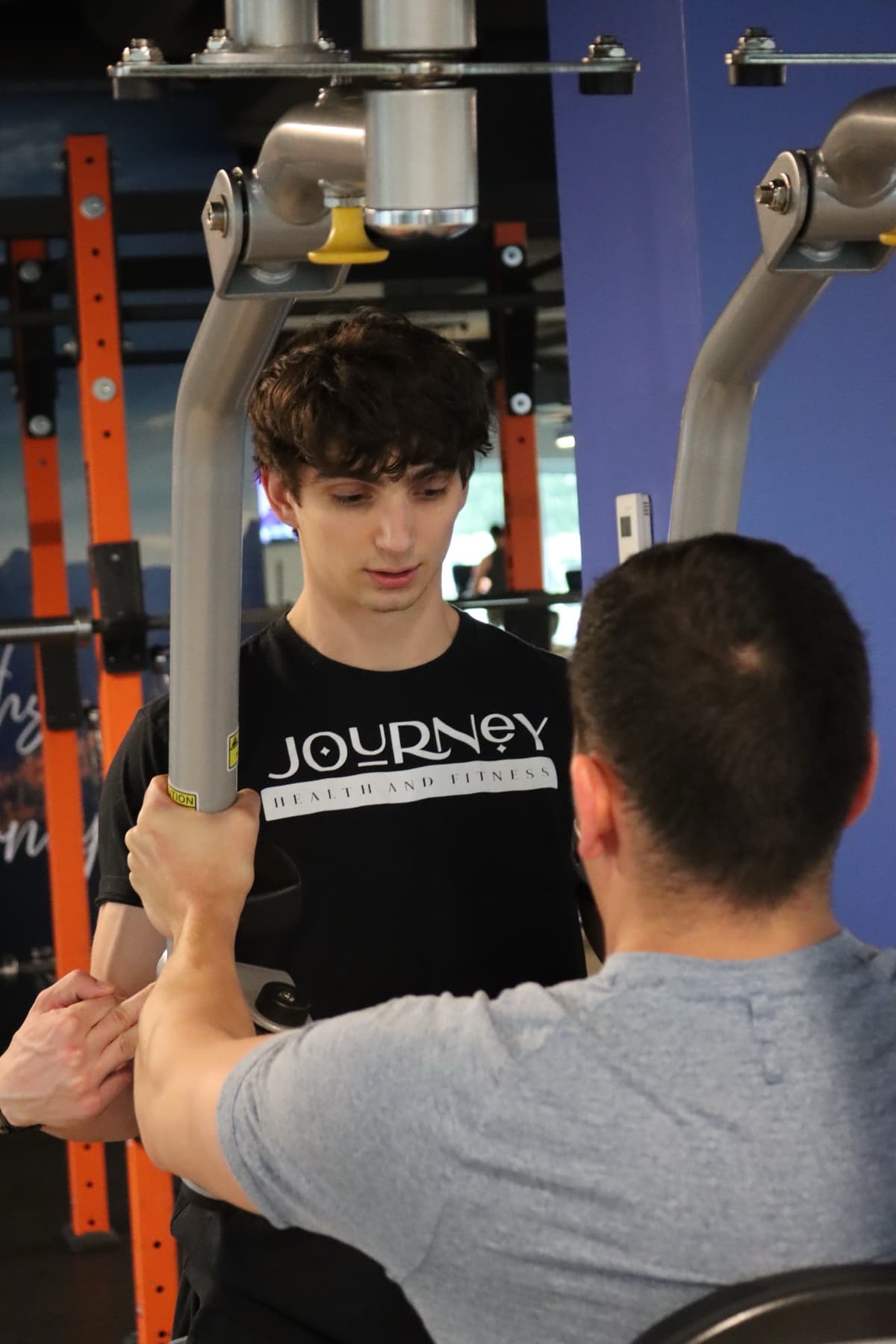
Our typical client is a 42–48 professional returning to structured lifting after a multi-year gap. You do not need a radical overhaul or extreme restrictions; you need progressive training programming, clear protein targets, and weekly 1:1 accountability.
- ✓ Customized lifting routines fitted to 3–4 days per week
- ✓Macro targets adjusted weekly based on scale & strength trends
- ✓ Direct 1:1 check-ins with Kris Oddo, NASM-CPT
- ✓ $100 one-time consultation call to map your first 90 days