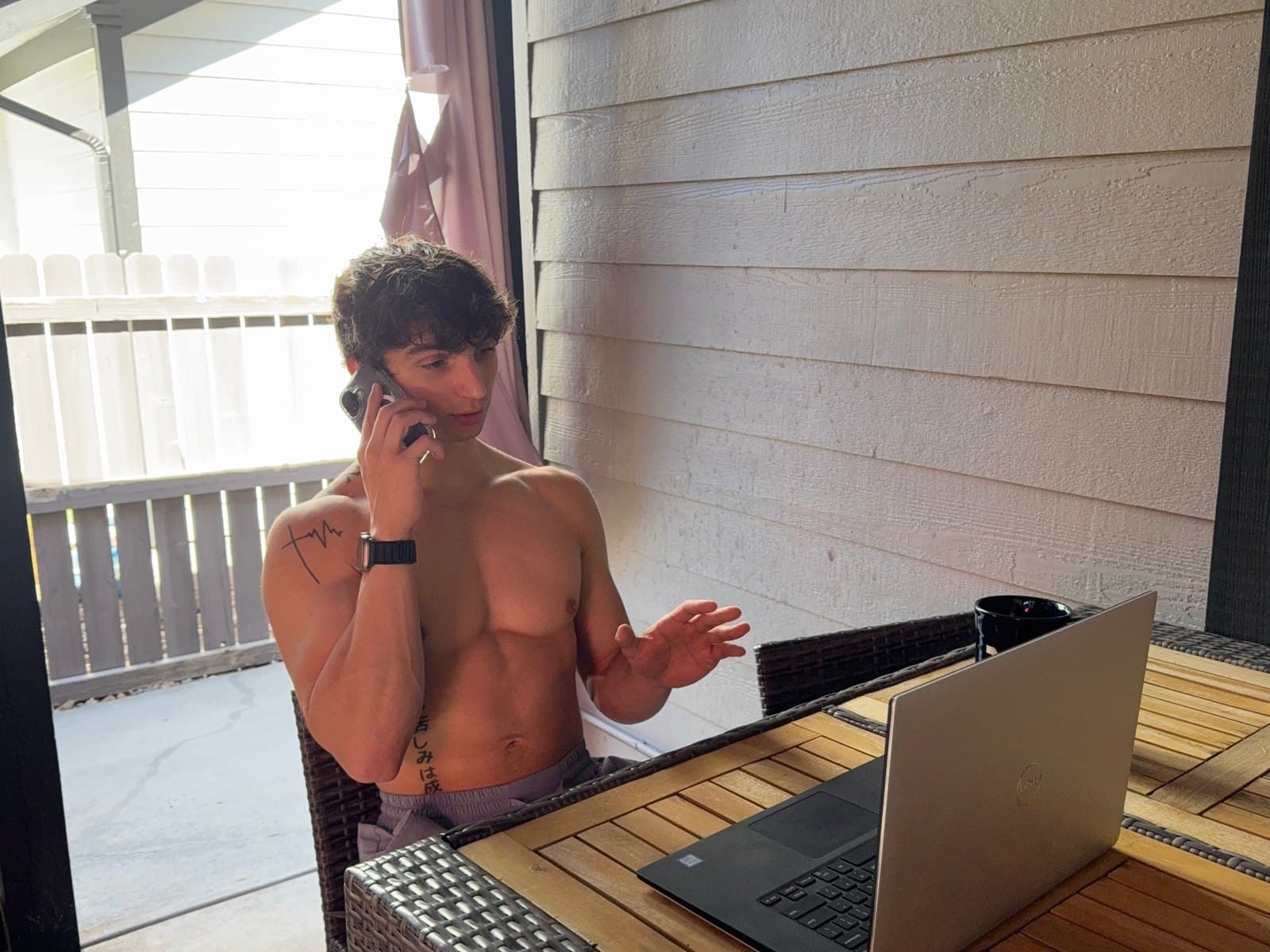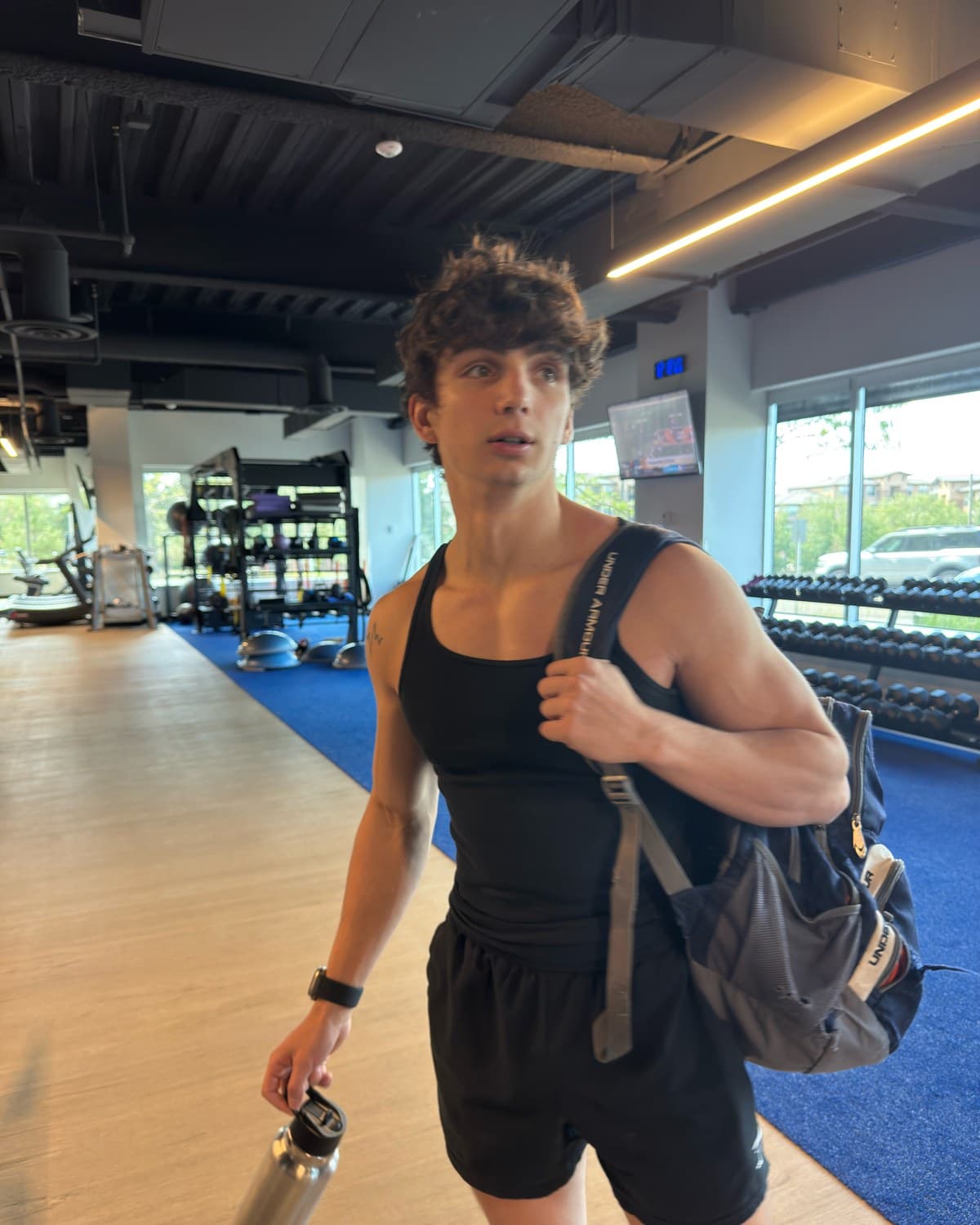
Kris Oddo, NASM-certified personal trainer, is the founder and head coach of Gains From Geebs (Geebs Coaching), a 1:1 online fitness coaching practice.
Who it's for
Fitness accountability coaching — when consistency is the real problem
You already know what to do. The missing piece is a coach who notices before a hard week becomes a silent quit — daily check-ins, weekly review, and a real human on the other end.
- 31K+ on Instagram
- NASM-CPT
- Weekly check-ins
The program was never the problem
Most men who hire a fitness coach have already tried multiple programs. They know what to eat. They know they should lift three days a week. They have had a gym membership for years. The problem is not knowledge or even willpower — it is having a system that holds them accountable to what they already know.
Consistency is the variable that separates the men who get results from the men who restart every few months with a new plan. When consistency is the real constraint, fixing the program is the wrong solution. Fixing the accountability system is the right one.
Geebs Coaching is built around this. The daily check-ins, the weekly review, and the direct access to Kris are not add-ons to the program. They are the product. The training and nutrition are the vehicle. Accountability is what makes it drive.
What daily accountability actually looks like
Daily accountability is not motivational messages. It is a practical check-in around the actual day: where training fits, what meals look like, how sleep and recovery went, and whether anything needs to shift before tomorrow.
Kris reads those check-ins and responds. If a workout got skipped, he knows before you have decided whether to write it off. If nutrition fell apart Tuesday, the adjustment happens Wednesday — not at the end of the week when the damage is done.
That real-time feedback loop is what separates 1:1 coaching from an app that logs your data without anyone actually looking at it.
Accountability versus motivation
Motivation is a feeling. Accountability is a system. You cannot build a fitness plan on motivation because motivation is not available on demand — it is highest when you start, lowest when you need it most.
Accountability does not require you to feel motivated. It requires you to check in, which you can do whether or not you feel like training. That daily friction of a real coach expecting to hear from you is a different mechanism than re-reading a motivational quote and hoping it sticks.
The research on this is consistent: supervised, coach-led training has dramatically higher adherence rates than self-guided training. The difference is not the program. It is the external accountability loop.
What happens when you go dark
With an app or a generic program, going dark is invisible. You stop logging, the streak resets, and no one notices until you decide to come back — if you do.
With a 1:1 coach, going dark is a signal. Kris notices. The check-in that did not come in triggers a message, a conversation about what happened, and a recalibration. The goal is not to shame anyone for a hard week — it is to prevent a hard week from becoming a hard month.
That is the specific failure mode that sinks most men who train alone: a hard week leads to two, which becomes a silent quit. A coach catches it at the week.
Why apps and streaks fail
Streaks are gamification. They measure logging, not progress. Most fitness apps optimized for streak maintenance are not optimizing for body composition change — they are optimizing for daily opens.
An accountability system built on a streak fails the moment the streak breaks, which is the exact moment the person most needs to stay in the game. A coach does not reset the relationship when you miss a day.
This is not a knock on fitness apps for what they are good at. Tracking is useful. Logging is useful. But if the problem is consistency, the streak mechanic is not the fix — a human who notices and responds is.
How long until consistency becomes self-sustaining
Most clients who start Geebs Coaching for accountability reasons find that the need for external accountability decreases over four to six months — not because the coaching is fading, but because the habits are becoming internal. The goal is not to create indefinite dependency on a coach. It is to build the pattern until it runs without external support.
Most clients stay for four to nine months. Some graduate to running their own programming; many re-sign for a second or third block while in a new training phase. The measure of successful accountability coaching is not years of retention — it is the client knowing what to do and being able to do it.
Proof trail
What backs the accountability claim
Accountability pages need more than the promise of daily check-ins. These are the visible results, public reviews, and methodology pages that show the coaching is a real operating system, not just a sales label.
Tracked 16-week average
25 lb
Average fat loss across 15 completed clients tracked over 16 weeks. Individual results vary.
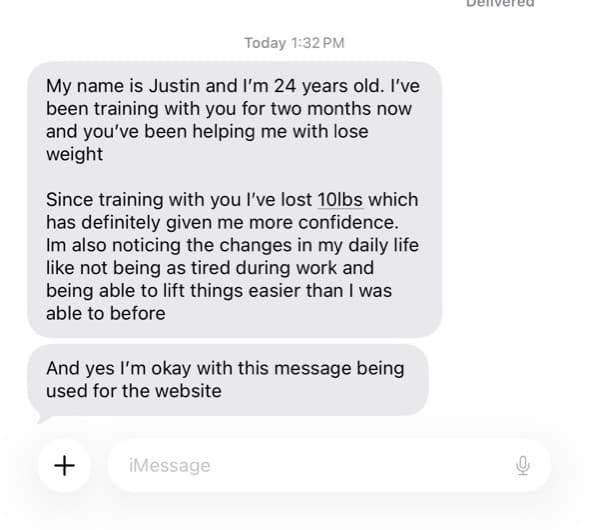
2 months - down 10 lb, more confidence, more energy
Down 10 pounds and carrying more confidence into daily life.
“I've lost 10 lb, which has definitely given me more confidence. I'm not as tired during work and I can lift things easier than before.”
Justin
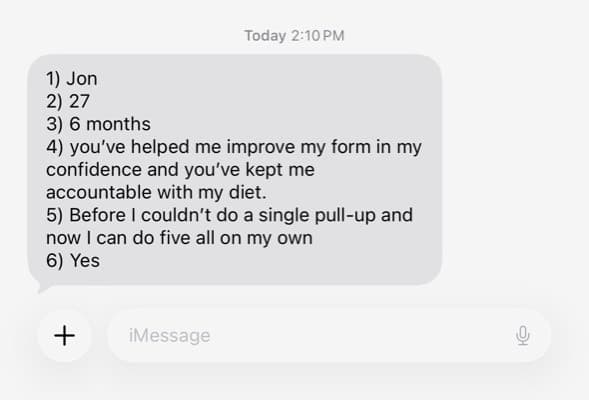
6 months - better form, diet accountability, 5 pull-ups
From zero pull-ups to five on his own.
“Before I couldn't do a single pull-up, and now I can do five all on my own.”
Jon Miller
Google review - 5/5
Public review mentioning Kris directly
“Great staff. Even greater experience. Would definitely recommend to anyone looking to improve themselves. Kris is the person you want to take it to that next level.”
Jake Ross - 11 months ago
Before you apply
Meet Kris before you decide.
Hear how Kris handles the application call, what he looks for, and how he decides whether 1:1 coaching is a fit.
Start your applicationRead the full accountability guide
The deeper dive on what accountability coaching is, the adherence research behind it, and how it differs from motivation is in the fitness accountability coach guide. Related: why you can't stay consistent with the gym.
Coaching with Kris starts at $400 a month. A one-time consult is $100, and the community is $24.99 a month. See what each one includes.
Before you read on
The plan below works off your numbers. Get them first.
Protein targets and calories depend on your bodyweight, not an average. The calculator gives you both in about a minute, so the rest of this article is something you can actually follow.
Free coaching tip
Want a useful coaching tip before you go?
Common questions
- What does daily fitness accountability actually look like?
- A daily check-in around the practical questions: where training fits today, how nutrition went, how sleep was, and whether anything needs adjusting before tomorrow. Kris reads and responds. If something fell off, the adjustment happens in real time — not at the end-of-week review when the week is already gone.
- Is accountability coaching the same as motivation coaching?
- No. Motivation is a feeling that comes and goes; accountability is a system you can use regardless of how you feel. The daily check-in does not require motivation. It requires showing up to the system, which is a lower bar than needing to feel ready to train.
- What happens if I stop checking in?
- Kris notices. A missed check-in triggers a message, not a streak reset. The goal is to catch the hard week before it becomes a hard month — which is the specific failure mode that ends most solo training attempts. Going dark is a signal, not a default.
- Does accountability coaching feel like being nagged?
- The framing is practical, not motivational. Check-ins are about logistics — where training fits, how meals went — not about reading you a speech. Most clients describe the accountability as a useful external pressure, not pressure that feels intrusive.
- Why do fitness apps and streaks fail for consistency?
- Streaks measure logging, not progress, and they reset the moment you miss a day — which is the exact moment you most need the system to hold. A coach does not reset the relationship when you skip a workout. The streak mechanic fails at the failure mode it was supposed to prevent.
- How long before I can stay consistent on my own?
- Most clients find the external accountability need decreases over four to six months as the habits become internal. The goal is for the pattern to eventually run without needing a coach to check in — not to create indefinite dependency. The coaching works itself toward graduation.
Stop restarting. Start building.
1:1 coaching is application-based — three questions, under two minutes. If 1:1 is not the right fit yet, the $100 one-time consultation call is available without an application.
If you want the study-backed answers first, see the research on whether you should track strength while losing weight and how many weekly sets it takes to build muscle.
Come back tomorrow
Coaching is the plan. The habit is what changes your body.
Staying on track is the daily part, so we publish one evidence-based finding every day.