In this guide
- Confidence comes from reducing decisions
- Track small wins
- Get feedback before bad habits stick
- Honest limits
- FAQ
Confidence comes from reducing decisions
The gym feels harder when every session starts with a question: what should I do today?
A simple plan removes that decision. You know the exercises, the order, the target reps, and what progress would look like. That structure makes it easier to walk in and start instead of scanning the room and second-guessing everything.
When men feel out of place in a gym, they often assume they need intense motivation or a massive surge of confidence before they can train well. In exercise psychology, confidence in your ability to carry out specific training tasks is studied as self-efficacy. Waiting to feel confident before you lift is backwards: certainty does not precede action, it is generated by action within a structured framework.
Work by Biscardi and colleagues (2024) explored how self-efficacy, daily effort, and perceived performance shape acute psychological responses to high-intensity lifting sessions in NCAA Division I collegiate student-athletes during a 4-week preseason strength training block (PMID 38662884). The researchers tracked data before and after lifting sessions, using a multilevel model to assess day-level and person-level variance in positive well-being and psychological distress. Interestingly, training session intensity itself did not predict changes in acute psychological responses across the 4-week training block. Instead, after controlling for an athlete's pre-exercise psychological state, higher self-efficacy, daily effort, and perceived performance reliably predicted higher positive well-being and lower psychological distress following the workout.
Crucially, Biscardi and colleagues found that self-efficacy moderated how daily effort and performance influenced psychological distress: when athletes experienced lower baseline self-efficacy, producing higher effort and perceiving better performance reduced their negative psychological response. The researchers concluded that cognitive variables play an important mediating role in the acute psychological response to high-intensity lifting, noting that coaches can identify and mitigate low cognitive states to facilitate a positive psychological response without altering the training prescription.
For anyone who feels hesitant walking onto the gym floor, that finding is liberating. You do not need to show up feeling invincible. Even when self-efficacy is low, walking in with a predetermined list of lifts where you can put in honest effort and note your performance directly reduces psychological distress and leaves you feeling better after the workout. The plan protects you from the paralyzing indecision that breeds anxiety.
Track small wins
Track weights, reps, form notes, and consistency. Small improvements make the process tangible.
A beginner who adds reps, controls the movement better, or completes the planned week is building evidence. That evidence matters more than trying to feel confident before starting.
Confidence is an emotional byproduct of competence, and competence requires measurable proof. When you write down your lifts, you remove the subjective fog of wondering whether you belong. A notebook or phone log turns an intimidating room into an objective tracking sheet: did you complete the planned sets, did you hit the target reps, and did you control the load?
This link between progressive, bite-sized physical tasks and psychological self-efficacy was demonstrated by Liang and colleagues (2024) in a 12-week randomized controlled trial examining progressive home-based strength and Tai-Chi exercise snacking in 90 community-dwelling older adults with impaired strength and balance (PMID 39574284). Participants were randomly allocated to either a 12-week progressive exercise and Tai-Chi snacking programme or a waitlist control group. Physical function—measured using the Short Physical Performance Battery (SPPB), a single-leg balance test, and a sit-to-stand test—was remotely measured at home via video calls at baseline, 4, 8, and 12 weeks, while self-reported psychological outcomes were tracked every 4 weeks with online questionnaires. In addition, a subset of 40 participants completed in-person lab assessments, and 26 intervention participants completed semi-structured interviews.
The results showed that progressive, accessible exercise bouts produced clear, compounding improvements. The 12-week intervention reliably improved SPPB strength compared to controls at each timepoint (estimated mean difference of 1.05 at week 4, 0.79 at week 8, and 0.79 at week 12) and balance (estimated mean difference of 0.71 at week 4, 0.57 at week 8, and 0.65 at week 12). In the lab subset, timed-up-and-go tests (estimated mean difference of 1.94 at week 4, 1.58 at week 8, and 1.1 at week 12) and total SPPB scores (estimated mean difference of 2.24 at week 4, 1.79 at week 8, and 1.76 at week 12) also favored the intervention group. In qualitative interviews, participants emphasized that the programme was accessible and beneficial, making it easy to implement while directly increasing their self-efficacy in physical activities.
When you break training down into manageable, structured segments, you eliminate the pressure to prove everything in a single day. Each tracked session provides concrete proof that your body is adapting, which replaces gym anxiety with genuine, earned confidence.
Get feedback before bad habits stick
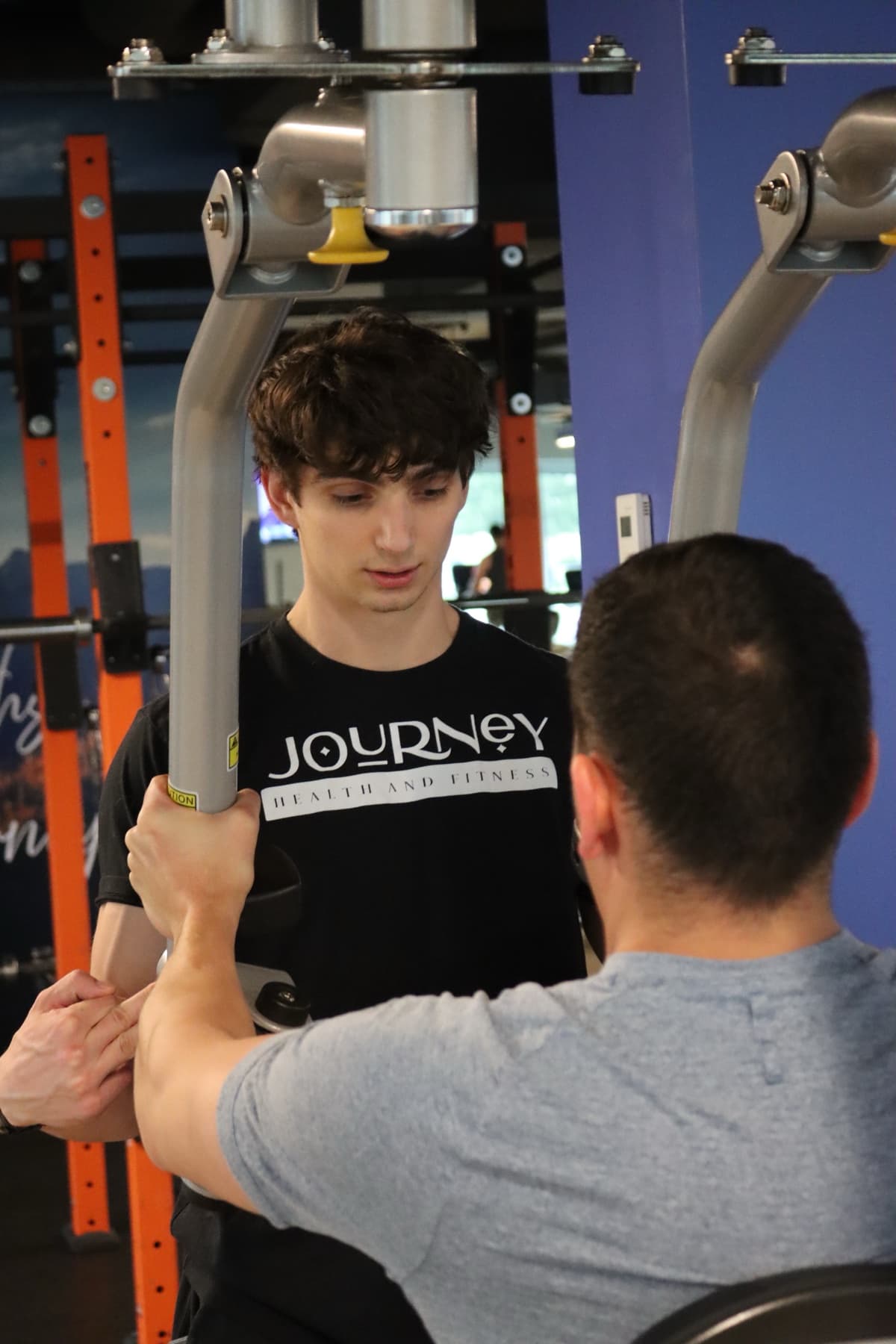
Coaching helps because feedback shortens the learning curve. You can fix form, choose better exercises, and stop changing the plan too often. It also helps separate normal beginner discomfort from a plan that actually needs adjustment.
When men start lifting, hesitation often comes from uncertainty around safety and technique: is this movement supposed to feel like this, or am I setting myself up for injury? Without an outside set of eyes or clear progression rules, that doubt turns every set into a tense, second-guessing exercise. Structured progression and accountability dismantle that fear by showing you exactly what is normal and keeping you within safe, productive boundaries.
The power of structured, safe exercise programming to elevate confidence was confirmed by Zhang and colleagues (2022) in a randomized controlled trial investigating a 12-week home-based lifting program in 72 elderly participants with osteoporosis (PMID 35704055). Participants were allocated to either a 12-week home-based lifting program or usual care controls. The primary outcome was physical function, evaluated by muscle strength and balance ability, while secondary outcomes tracked exercise self-efficacy, falling efficacy (confidence in not falling), and health-related quality of life, with 68 subjects completing the final analysis.
Zhang and colleagues found that improvements in physical function were reliably greater in the lifting group compared to controls. On a psychological level, exercise self-efficacy and falling efficacy improved reliably in the lifting group, whereas no reliable change was observed in the control group. Furthermore, most dimensions of health-related quality of life improved, adherence reached 85.29%, and no adverse events related to the exercise occurred throughout the trial. The authors concluded that a 12-week lifting program was a safe non-pharmacological therapy that improves physical function, boosts exercise self-efficacy, reduces fear of falling, and improves quality of life.
The takeaway for anyone building gym confidence is clear: structured, repeatable movement patterns do not just make you physically stronger; they fundamentally shift your psychological relationship with exercise. When you follow a proven template, adherence remains high, fear drops, and self-efficacy grows week after week.
The goal is to make training feel familiar enough that consistency becomes realistic. If you prefer building that foundation at home first, see online fitness coaching for men who hate the gym.
For beginner-friendly strength equipment and training tools to support your gym sessions, browse the Titan Forge beginner strength and gym confidence collection.
Honest limits
- Collegiate athlete performance dynamics: The study by Biscardi and colleagues (2024) evaluated NCAA Division I collegiate student-athletes over a 4-week preseason training block (PMID 38662884). While the trial confirmed that higher self-efficacy, effort, and performance perceptions reduce post-exercise psychological distress, collegiate student-athletes possess extensive training backgrounds and operate in structured collegiate environments. Men who are stepping into a commercial gym for the first time or returning after a decade off face distinct baseline anxieties, such as unfamiliar machinery and crowded weight rooms, that elite athletes do not experience.
- Older adult cohorts in home environments: Both Zhang and colleagues (2022) and Liang and colleagues (2024) studied home-based exercise protocols in older demographics—72 elderly individuals with osteoporosis (PMID 35704055) and 90 pre-frail older adults with impaired strength and balance (PMID 39574284). While both 12-week randomized trials demonstrated reliable improvements in muscular strength, balance, and exercise self-efficacy, the training took place in home settings. Exercising at home eliminates the social friction and perceived judgment of a commercial gym floor. Building initial movement competence at home is a proven strategy to boost self-efficacy, but transitioning to a public gym requires getting comfortable with the social environment as well.
- Observational and exploratory study designs: The findings in Biscardi and colleagues (2024) stem from an observational field design analyzing acute responses around lifting sessions (PMID 38662884), while Liang and colleagues (2024) used an exploratory mixed-method framework with remote video measurements and a 40-subject lab subset (PMID 39574284). While these methodologies yield valuable real-world data on psychological variables and functional adaptations, long-term randomized trials in working-age men over multiple years are needed to track how gym confidence consolidates across extended training careers.