In this guide
- The plan has to survive the week
- What the science says about adherence and barriers
- What coaching changes
- Why remote guidance and time-efficient lifting work
- Who this is for
- Honest limits
- FAQ
The plan has to survive the week
A fitness coach for busy professionals has to account for late meetings, client dinners, travel, low steps, and decision fatigue.
That means the program cannot depend on perfect weekdays. Training needs a fallback structure, nutrition needs simple anchors, and accountability needs to catch drift early.
The best plan is not the most advanced plan. It is the plan that gets executed when the week is not clean. When work hours spike or travel disrupts your routine, a fragile program falls apart completely. An effective program builds in minimal effective doses, clear default choices, and simple adjustments so progress continues even during chaotic weeks.
Most professionals do not fail because they lack effort or drive. They fail because standard fitness plans assume an empty calendar, predictable energy, and zero work stress. When reality collides with an inflexible routine, missed workouts compound into abandoned goals.
What the science says about adherence and barriers
Why do capable professionals struggle to maintain consistent habits on their own? Behavioral science provides concrete answers about how barriers and motivators operate.
In a systematic review of the qualitative literature, Deslippe and colleagues (2023) analyzed 35 studies to identify the core barriers and facilitators that determine adherence to diet, physical activity, and lifestyle interventions (PMID 36782207). The authors categorized these factors across three distinct levels:
- Individual level: Attitudes, personal concern for health, and noticeable physical changes.
- Environmental level: Social support, social accountability, and changeable as well as unchangeable aspects of the community environment.
- Intervention level: Delivery methods, program design, and content structure.
Deslippe and colleagues emphasized that intervention success depends on building self-regulatory skills through structured Behavior Change Taxonomies (BCT). They concluded that lifestyle interventions that foster self-regulatory skills, provide opportunities for social engagement, personalize goals, anticipate upcoming barriers with participants, and plan for the tapering off of intervention supports achieve far better habit adherence (PMID 36782207).
These findings highlight why generic fitness routines fail under pressure. Without personalized goal structures, social accountability, and active strategies to anticipate upcoming work barriers, consistency collapses as soon as professional demands increase.
This behavioral framework is supported by a comprehensive systematic review by Spiteri and colleagues (2019), who evaluated 55 articles (identified from 9,400 search results across seven databases) examining barriers and motivators for physical activity participation in middle-aged adults (50–64 years) and older adults (65–70 years) using the theoretical domain framework (PMID 31141447).
Spiteri and colleagues found that environmental factors and limited resources were the most commonly reported barriers across both age groups. However, the primary motivators shifted between demographics:
- Middle-aged adults: Identified goal setting, the belief that activity will be beneficial, and social influences as their most important motivators.
- Older adults: Emphasized social influences, reinforcement, and direct assistance in managing change as their top motivators.
For a busy professional, these findings show why isolated motivation is insufficient. Consistent execution requires clear goal setting, positive reinforcement, social support, and structured assistance in managing schedule changes—the exact behavioral drivers identified by Spiteri and colleagues (PMID 31141447) and Deslippe and colleagues (PMID 36782207).
What coaching changes
Coaching gives the plan a decision-maker. If travel hits, the training week is adjusted. If calories run high for two days, the weekly average is recalibrated.
That matters for professionals because the bottleneck is rarely knowledge. The bottleneck is consistency under pressure.
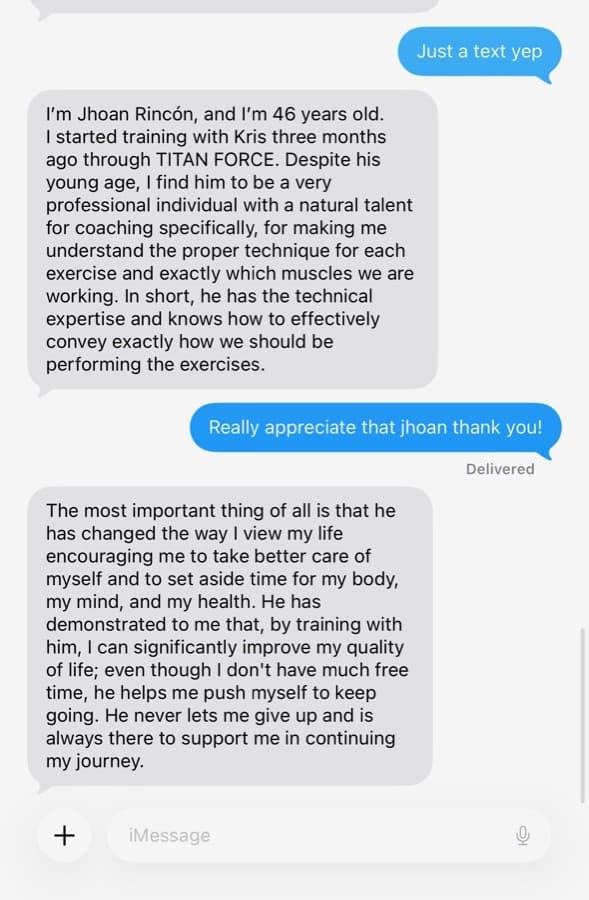
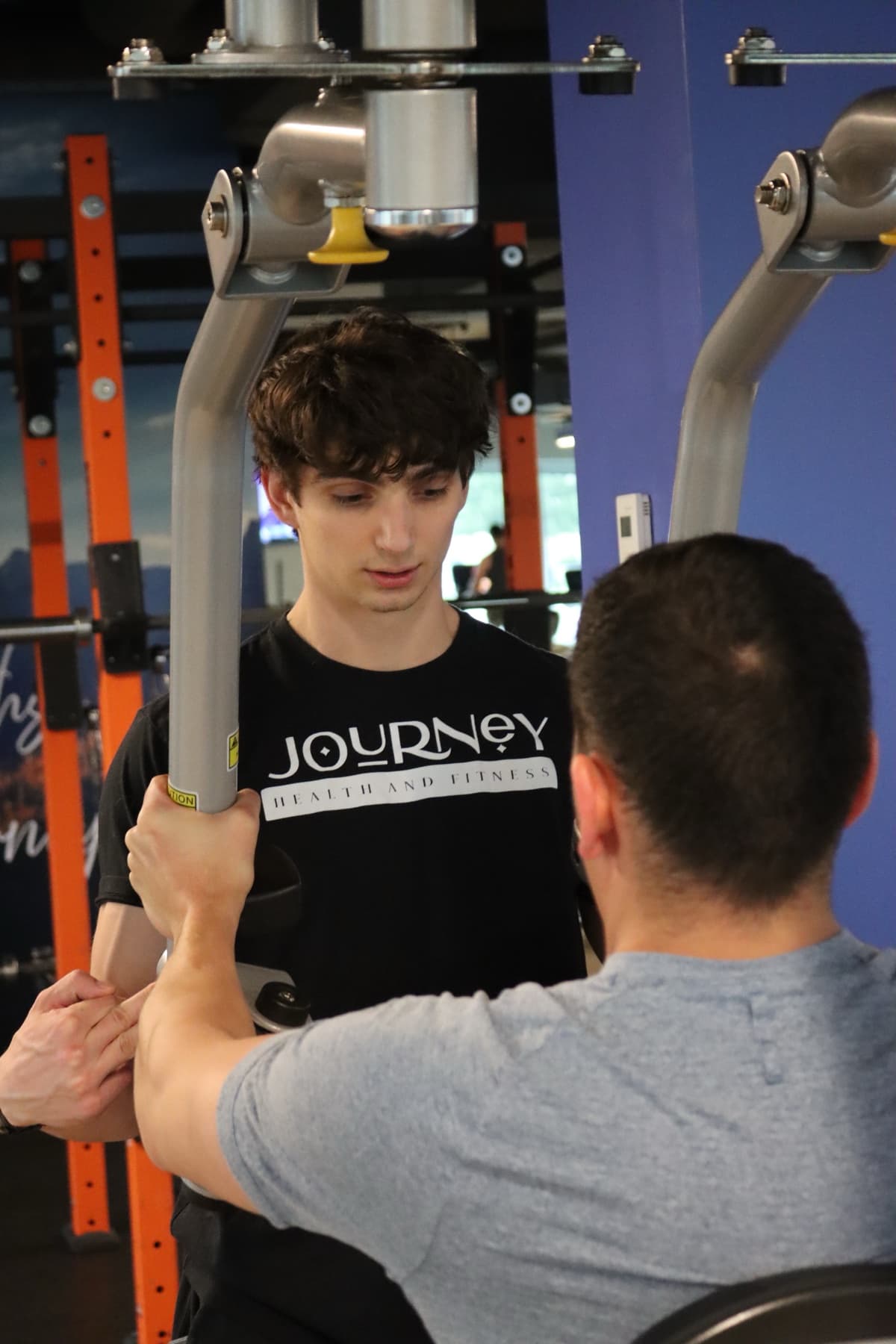
Kris's role is to keep training, protein, recovery, and accountability connected so missed days do not become missed months.
When you manage demanding projects, make high-stakes decisions all day, and balance personal commitments, decision fatigue is real. Having a coach removes the mental burden of guessing what adjustments to make. Instead of wondering whether to cram three missed workouts into a weekend or slash calories after a client dinner, you follow a clear, adjusted roadmap tailored to your actual schedule.
Coaching provides:
- Adaptive weekly programming: Shifting workout volume and frequency based on travel, sleep quality, and work deadlines rather than forcing rigid splits.
- Flexible nutrition guidelines: Establishing protein and calorie baselines that work with business travel and restaurant dining instead of restrictive meal plans.
- Structured weekly accountability: Regular asynchronous check-ins that evaluate lifting progress, body measurements, biofeedback, and recovery.
- Proactive barrier management: Anticipating upcoming schedule bottlenecks before they derail your momentum.
Why remote guidance and time-efficient lifting work
Many professionals wonder whether remote coaching and short, focused workouts can produce meaningful strength and body composition changes compared to spending hours in a commercial gym.
The clinical evidence confirms that remotely delivered, home-based lifting routines are both highly feasible and safe. In a pilot randomised controlled trial, Fyfe and colleagues (2022) examined the feasibility and acceptability of a remotely delivered, home-based pragmatic resistance 'exercise snacking' intervention in community-dwelling adults (PMID 35751032).
Fyfe and colleagues monitored participants remotely and reported exceptional engagement and safety outcomes:
- 100% participant retention throughout the intervention.
- High adherence rates: 97% for once-daily, 82% for twice-daily, and 81% for thrice-daily sessions.
- Strong safety profile: Only 2 adverse events across 1,317 total exercise snacking sessions.
- High participant satisfaction: 75% of participants rated their enjoyment as ≥4 on a 5-point Likert scale, and 82% reported planning to continue similar home exercise.
- Feasible remote functional tracking: The trial demonstrated that assessing physical function via videoconferencing was fully feasible, with 4-week chair-stand changes (5-STS d range 0.4–1.4; 30-STS d range 0.7–0.9) matching the patterns seen in control groups (d = 1.1 and 1.0, respectively).
The trial by Fyfe and colleagues (PMID 35751032) demonstrates that remote delivery and structured monitoring can maintain high adherence and safe performance. You do not need long daily gym sessions to build strength and maintain physical function; focused, well-structured lifting blocks combined with remote tracking provide a reliable framework for busy schedules.
Who this is for
This fits professionals who can commit to training but need structure around the real constraints: time, energy, meals out, work stress, and accountability.
It is not a magic schedule. It is a coach-led process that makes the defaults obvious and the adjustments faster.
Online coaching is ideal for professionals who:
- Want a clear, time-efficient lifting plan that fits into three 45-minute sessions per week.
- Need realistic nutrition guidelines for dining out, client events, and travel without tracking every single gram.
- Value expert feedback on exercise form, recovery management, and weekly progression.
- Want objective accountability to eliminate the drift that happens when work gets intense.
Who this is not for:
- Individuals who want an in-person trainer to physically count reps during every workout.
- Anyone looking for quick fixes or extreme diets.
- Trainees who prefer to program and adjust their own routines without outside input.
If 1:1 is too much right now, the $24.99/month community or a $100 one-time consultation call can be a lower-touch starting point.
For streamlined nutrition protocols and time-efficient fitness essentials, explore the Titan Forge busy professional fitness and nutrition collection.
Honest limits
When interpreting the research on behavior change and remote exercise interventions, keep these honest limits in mind:
- Study demographics and sample makeup: In the qualitative systematic review by Deslippe and colleagues (2023, PMID 36782207), 46% of the 35 included studies were conducted in North America, and the majority included a higher proportion of female participants (86% in mixed-sex studies, 26% female-only). While fundamental behavioral principles such as social accountability and goal personalization apply across populations, busy corporate professionals navigate unique corporate schedules and travel demands.
- Age groups in adherence literature: The systematic review by Spiteri and colleagues (2019, PMID 31141447) evaluated 55 articles focused specifically on middle-aged (50–64 years) and older adults (65–70 years). Younger professionals (aged 25–45) share similar environmental and resource constraints, but may place different emphasis on specific aesthetic, strength, or performance goals.
- Pilot trial duration and design: The study by Fyfe and colleagues (2022, PMID 35751032) was a 4-week pilot feasibility trial in community-dwelling older adults evaluating brief exercise snacking bouts. As the authors noted, larger randomized controlled trials over longer durations are required to establish extended muscular and functional adaptations across broader populations.