In this guide
- The real problem isn't sitting — it's what sitting replaced
- The calorie math of sitting all day
- Desk-worker countermeasures: what actually works
- Lift three days per week — resistance training is non-negotiable
The real problem isn't sitting — it's what sitting replaced
A desk job does not slow your metabolism. What it does is eliminate the ambient movement that used to happen automatically: walking between meetings, standing, climbing stairs, fidgeting, carrying things. In a physical job or an active lifestyle, that movement burns 300 to 2,000 extra calories per day without you ever thinking about it. In a fully sedentary desk job, that energy output collapses — and the belly grows in the gap.
This is Non-Exercise Activity Thermogenesis, or NEAT: the calories you burn from everything that isn't formal exercise, eating, or sleeping. Research from Dr. James Levine at the Mayo Clinic found that NEAT can vary by up to 2,000 calories per day between two people of similar size — the difference between a construction worker and an office employee.
That is not a small gap. It is a variable large enough to determine whether you gain weight, maintain, or lose fat, entirely independent of your gym time.
For desk workers, NEAT collapse is the primary fat-gain mechanism. It is also the reason that three gym sessions per week, while valuable, cannot fully compensate for a sedentary baseline. Three hours of training per week versus 50 sedentary hours is not a winning ratio. The fix is rebuilding daily movement output — not replacing the job, but layering movement back into the hours the job removed it.
The calorie math of sitting all day
Here is a concrete number: a study on treadmill desks found approximately 105 extra calories burned per hour of slow walking versus sitting. Across a five-day week at one hour per day, that is 525 extra calories of weekly output. Over a month, that is roughly 2,100 calories — equivalent to a meaningful weekly deficit added purely through ambient movement, no diet change required.
Dr. Levine's research on lean versus obese sedentary office workers found that the lean group stood or walked roughly two and a half hours more per day than the obese group — despite matching jobs and similar formal exercise. If the sedentary group adopted the posture allocation of the active group, the estimated additional expenditure was roughly 350 calories per day.
The desk-worker math runs the other way too. If you moved an hour each day in your previous job or lifestyle and now you don't, the calorie gap from NEAT alone is large enough to produce steady fat gain even if you did not change a single food choice. The belly that appeared when you took the desk job, or switched to remote work, or started a commute-heavy career — that is the NEAT story.
Understanding this math is useful because it clarifies the target. You do not need to work out twice as hard to compensate for a sedentary job. You need to rebuild the non-exercise movement that sitting removed. Steps, standing breaks, walking meetings, a walking pad, lunchtime walks — these are not consolation prizes. They are the primary lever.
Desk-worker countermeasures: what actually works
The most effective countermeasures are the ones that survive a full workday without requiring willpower. Strategies that depend on remembering to move every hour — or forcing yourself off a deep work sprint — have low compliance rates. The goal is to build movement into the architecture of the day rather than adding it as an extra task.
A daily step target is the most reliable anchor. For desk workers, 8,000 steps per day is a strong baseline. Fewer than 5,000 is effectively sedentary. The step goal does not care whether the steps come from a morning walk, a walking pad during calls, a lunchtime circuit of the block, or an evening walk after work. The source is flexible; the number is not.
Walking pads under standing desks work well for light cognitive tasks — calls, reading, asynchronous reviews, shallow work. They are less useful during deep focus work that requires fine motor input. The research on treadmill desks and cognitive performance shows minimal impact on task quality at slow walking speeds (1–2 mph), which means the real barrier is habit formation, not performance.
Standing breaks every 60–90 minutes interrupt the seated-all-day pattern. This is not about burning significant calories in the break — it is about preventing the 6–8 hour static block that drives stiffness, lowers mood, and is associated with worse metabolic markers even among people who exercise regularly. One study found that even brief walking interruptions to prolonged sitting improved postprandial glucose and insulin responses.
The countermeasures stack. A walking pad at the desk handles shallow work hours. A step-count target ensures you hit a floor even on days you skip the pad. A lunchtime walk handles the midday reset. These together can close most of the NEAT gap from a sedentary job without adding formal gym sessions.
Lift three days per week — resistance training is non-negotiable
Rebuilding NEAT handles the daily movement side. Resistance training handles the muscle and metabolic side. Both matter, and they solve different problems. NEAT rebuilding is not a substitute for lifting, and lifting is not a substitute for daily movement.
For desk workers losing belly fat, resistance training does two things that cardio and walking cannot. It preserves or builds muscle during the calorie deficit — which matters because you want to lose fat, not just weight. And it directly improves insulin sensitivity, which makes the body handle fuel better and partition calories toward muscle rather than fat storage.
Three weekly sessions built around compound movements — squats, deadlifts, presses, rows — is the right starting point. If you want the full program for desk workers including exercise selection and posture-relevant programming, read the{' '} companion guide on{' '} strength training for desk workers.
For belly-fat purposes, the key principle is progressive overload: lift a little more each week across a structured plan, keep protein high, and the fat-loss phase produces a leaner body rather than just a lighter one.
If the workday is unpredictable — which it usually is in remote or hybrid work — give every training session a fallback version. A shorter session, fewer accessories, or a home alternative. Missing a planned session entirely is the failure mode; a shorter version is not. A three-day-a-week habit that survives a demanding week beats a five-day plan that collapses when things get busy.
Nutrition defaults for the desk-worker day
Spot reduction is a myth — belly fat falls only when total body fat falls. That still requires a calorie deficit. For desk workers, the challenge is not understanding this; it is building food defaults that hold through a workday full of easy access to snacks, long sedentary stretches that blur hunger cues, and stress eating that feels like appetite.
The mechanics of fat loss for desk workers are covered in depth in the base belly-fat guide at{' '} how to lose belly fat in your 30s. The desk-worker-specific layer is structure: protein at every meal to anchor intake and preserve muscle, a predictable lunch that does not depend on whatever the team ordered, and planned snacks so the afternoon stretch does not become uncontrolled grazing.
Protein target: 0.8 to 1 gram per pound of bodyweight. That is the most important nutrition rule for a desk worker in a fat-loss phase, because it keeps muscle on while the deficit does its job. Everything else — carb timing, meal frequency, specific foods — matters far less than hitting protein and holding the deficit.
One desk-worker trap worth naming: the sedentary day can make hunger signals unreliable. Boredom, stress, and the physical proximity of a well-stocked kitchen (for remote workers) all register similarly to hunger. A structured meal schedule — protein breakfast, timed lunch, planned afternoon snack — removes the decision-making that leads to grazing and makes it far easier to hold the deficit through a slow workday.
How daily accountability keeps the desk-worker plan alive
The failure mode for desk workers is not knowledge. It is drift. The day absorbs your attention — meetings, deadlines, Slack, deliverables — and by 7 PM the training window passed, the step count is 2,000, and dinner is whatever is in the fridge. Repeat that five days per week and the plan dies without a single conscious decision to abandon it.
The fix is bringing the plan into the day rather than waiting for the day to make space. This means checking in before the first meeting: training window confirmed, protein breakfast logged, step target acknowledged. It means a recurring calendar block for the walk, the lift, and the meal. Not a hope — an appointment.
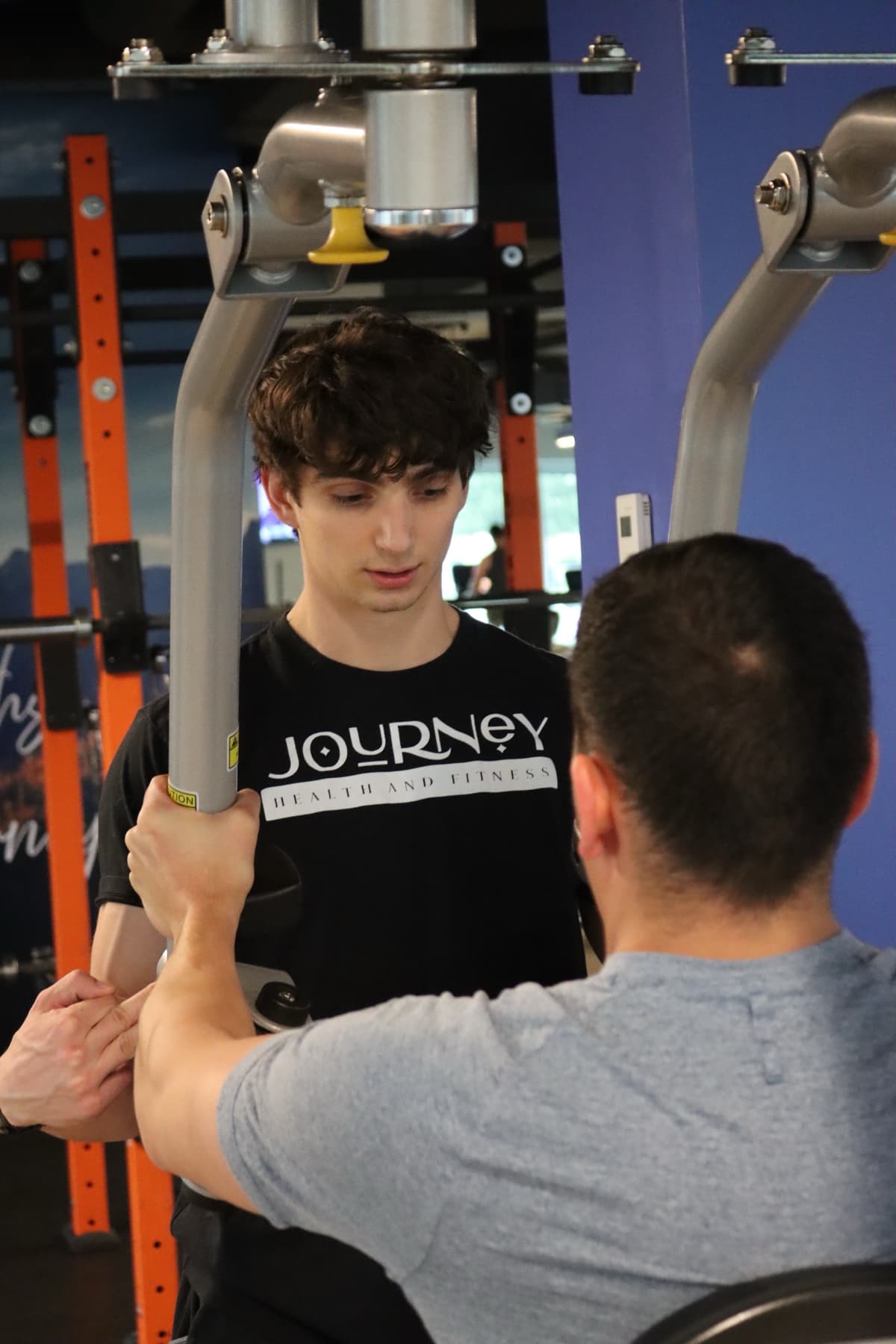
For remote workers and developers, the win is a plan that keeps getting pulled back into view. That is what Kris builds with 1:1 clients: a daily accountability system that fits inside the job, not one that competes with it. Steps, training windows, protein anchors, and weekly check-ins that catch drift before it becomes a derailment.
More questions
How is the desk-worker fat-loss plan different from the general belly-fat guide?
The general belly-fat mechanics — calorie deficit, spot reduction is a myth, the belly responds last — are covered in depth in the men in their 30s belly-fat guide. The desk-worker guide focuses on the NEAT collapse problem, the specific countermeasures (steps, walking pad, scheduled breaks) that address it, and the accountability structure that keeps the plan alive inside a demanding workday.